Fish Oil for Allergies and Focus

I grew up allergic to everything.
I mean that literally. When I was a kid in the 1970s, walking into a restaurant meant walking into a wall of cigarette smoke, and by the time we were seated my eyes were red and streaming, wrists rubbing at them, and the whole meal was ruined before it started. Cutting grass? Covered in hives from wrist to elbow within an hour. Raw egg yolks or uncooked almonds? I woke up looking like Rocky Balboa — both eyes swollen almost shut.
My mother took me to an allergist. He was a large man with famously bad breath — the kind you remember decades later — and his office ran the same drill every time. I would sit shirtless on the paper-covered table while he scored little grids into my forearms and my back with a lancet, then dropped a bead of one allergen after another onto each scratch and labeled them with a marker. Then we waited. Twenty minutes later, the map came in. Almost every square was raised, red, and hot.

The verdict, delivered like it explained something: "You're allergic to everything."
That was the medical opinion, and for a while I believed it was a life sentence. Chicken. Eggs. Grass. Dust. Almonds. Pollen. Cats. The list read like the shopping list of a normal kid's life. According to the labels on my forearms, I was not supposed to have any of it.
Decades later, when the modern blood test for allergies came out, my wife sent one in for me — I forget which company, one of the early ones. The result came back looking almost identical to the map on my back at nine years old. Same list. Same verdict. Whatever this was, it had not gone anywhere.
The dog thing
Here is the one that never got easier.
I love dogs. I have always loved dogs. And when a friendly dog walks over and puts a face in your hand, you cannot help wanting to pet it, hug it, let it climb on you — nobody can. So most of the time, I do. And within seconds — not minutes, seconds — the eyes start itching, the sneezing kicks in, the whole familiar chemistry of the reaction starts running.
Every dog is a math problem I do not want to solve: how much dog do I want before the rest of the day is gone?
The Benadryl years — and the wreck that came with it

The other memory of that decade is the medicine cabinet. Benadryl for the hives. Benadryl for the sneezing. Benadryl for the nights when my eyes were too swollen to sleep on. It worked, in the sense that it turned the reaction off. It also turned me off — thick tongue, dry mouth, ten hours of sleep that felt like six, mornings I could barely wake up for. That is its own story and I will get to it in another post. For now: the antihistamine years were not a solution. They were an off-switch for a body that would not stop reacting, and it cost me half of every day.
What changed — part one
The first thing that helped was the food.
Somewhere in my twenties I started paying attention to what I was eating, not because I read a book about it but because I felt different when I ate one way versus another. I leaned into raw fruit and vegetables. I started juicing — carrots, celery, apples, ginger, whatever was in the crisper. I did not have a theory. I had a feeling that this was helping, and it was.
Some of it, I am sure, was that I was growing up and my immune system was settling down — the classic "kids grow out of it" story. Some of it was that I was no longer sitting in cigarette smoke for two hours at every family dinner. But some of it was the food itself. The reactions did not disappear, but they thinned out. The floor came up.
What changed — part two
Then, somewhere in the mid-to-late 2010s, I started taking fish oil.
I do not remember the exact moment. It was not a diagnosis or a doctor's recommendation. It was around the same time everyone was talking about omega-3s for heart health, and I figured I would try it. I bought a bottle. Two capsules a day, most mornings.
A few months in, I noticed I was not getting sick as much. Colds that used to sit on my chest for two weeks were shorter, milder, or did not arrive at all. Then, over the next year or two, I noticed something more specific. When I did get a flare — went out to cut the grass, spent an hour in a friend's dusty garage, walked into a house with a cat — I could pop two fish oil capsules and, within ten or fifteen minutes, the reaction would ease. Not to zero. But down enough that I could keep going.
That was not an antihistamine. That was food working faster than any pill I had ever been given as a kid.
It was better than Benadryl. And it did not turn me off in the process.
I cannot prove that timing mechanistically. Ten or fifteen minutes is faster than the membrane-level omega-3 effects the textbooks describe, and some of it may be a real fast anti-inflammatory action, some of it may be that my system settled once I stopped grinding through the reaction, and some of it may be plain placebo. I am not going to tell you it is any one of those. I can only tell you what I noticed, over and over, for years.
Fish oil isn't a supplement
This is the part I want to land carefully, because it matters to how I think about all of this.
Look at a bottle of fish oil. Read the label. What is in there? Oil pressed out of a fish. Sometimes cod. Sometimes anchovy and sardine. Sometimes salmon. That is it. It is not a molecule assembled in a lab and then compressed into a tablet with binders and fillers. It is not a synthetic imitation of a nutrient. It is the same fat you would eat if you sat down to a plate of sardines on toast, only concentrated and packaged so you can take it without cooking a fish at seven in the morning.
That is not a supplement. That is a food, in a different form factor.
Legally, the bottle sits in the supplement aisle — that is the FDA category and I am not arguing with the label. Biologically, though, I think of it as a food in a capsule, and that changes how I decide what to do with it.
It is closer to olive oil than it is to a multivitamin. Olive oil is olives, pressed. Fish oil is fish, pressed. Neither one belongs in the "pills off the shelf" cabinet that I wrote about here — the one with the folic acid, the synthetic B12, the isolated vitamin D3 in vegetable oil, the calcium carbonate carved out of rock. Those are lab constructions. Fish oil is a fish.
Olive oil is olives, pressed. Fish oil is fish, pressed. That is not a supplement. That is a food, in a different form factor.
The first gene layer — why I was allergic to everything
Years later, after I built foodZipper and ran my own DNA through it, I finally saw what had been going on the whole time.
Three genes lit up together. Not one — three.
HDC is the enzyme that produces histamine — it converts the amino acid histidine into the histamine molecule your mast cells then release when triggered. I carry the higher-activity form of HDC, so my baseline production runs at the upper end. More histamine gets made per day than the average person makes.
DAO is the enzyme in your gut lining that clears dietary histamine — the histamine you get from wine, aged cheese, cured meats, leftovers, fermented foods, and (importantly) certain fresh foods like tomato, spinach, and shellfish that carry it naturally. I carry two DAO-slowing variants, one of them on both copies. My gut clearance runs below average.
HNMT is the enzyme that clears histamine inside tissues — in the brain, the airways, the skin. When HNMT is slow, tissue histamine takes longer to come down after a trigger. That is the "hives an hour after cutting the grass and they last all afternoon" pattern.
All three at once is what the engine calls "makes more, clears less." It is the fullest genetic signature for histamine intolerance and reactive-allergy patterns that consumer DNA data can show. It does not diagnose anything. But it explains a childhood.
I was not "allergic to everything." I was a kid whose body made more histamine at baseline and cleared it more slowly than the kids around me, so every trigger — the smoke, the grass, the raw egg — landed harder and lingered longer. The scratch test was not measuring "allergies" in the way I thought. It was measuring a histamine system that was already turned up loud and did not have much room left before it spilled over.
I was not allergic to everything. I was a kid whose histamine system was turned up loud, and everything landed harder because of it.
The second gene layer — why fish oil, specifically
Here is where it gets interesting.
Plant omega-3 — the ALA in flaxseed, chia, walnuts, and leafy greens — is not the same molecule as the EPA and DHA your brain and immune system actually use. Your body has to convert ALA into EPA and DHA, and that conversion happens through two enzymes called FADS1 and FADS2. Common variants in both genes slow the conversion down.
My conversion rate is somewhere around half of what a fast-converter carries. That means every walnut, every teaspoon of flax, every bowl of leafy greens contributes less usable EPA and DHA to my body than it would to somebody else's. I can eat plant omega-3 all day and still be running on empty at the receptor level, because the pipeline in the middle is throttled.
Fish oil bypasses the pipeline. It arrives already as EPA and DHA. No conversion needed. The FADS variants become irrelevant, because the enzymes are not being asked to do the work.
That is the specific reason fish oil worked for me the way it did, and it is why anybody with FADS variants — a big chunk of the population — should probably know their status before deciding whether flax and chia are enough.
What actually happens when a fish-oil capsule calms a hive
The mechanism is not what most people think.
Fish oil is not an antihistamine. It does not compete with histamine at the receptor the way Benadryl or Zyrtec does. It works one step further upstream — at the mast cell itself, before the histamine ever gets released.
DHA gets metabolized into a family of anti-inflammatory molecules called specialized pro-resolving mediators. One of them is called Protectin D1, and it directly inhibits mast cell degranulation — meaning when a mast cell gets the "release your histamine" signal, Protectin D1 makes it less likely to actually do it. Another EPA metabolite, 15-HEPE, dampens the same pathway through a slightly different route. And when the cell membrane of a mast cell is rich in EPA and DHA instead of omega-6 arachidonic acid, the mast cell is structurally less prone to spontaneous degranulation in the first place.
So the difference between fish oil and Benadryl is where each one intervenes. Benadryl waits until the histamine has already been released and then blocks the receptor from receiving the signal. Fish oil goes further upstream and reduces how much histamine gets released in the first place. Different point in the chain.
For a system like mine — one that makes more histamine and clears less of it — reducing release at the source is exactly the leverage point that matters most.
Benadryl blocks the receiver after the message is sent. Fish oil turns down the transmitter before it sends the message. My system needed the transmitter turned down.
The chess story
Here is the small thing I never expected fish oil to change.
I play chess. Not seriously, but consistently — enough that I have a rating and I can watch it move around depending on how sharp I feel. And I have noticed, over a couple of years now, a pattern that I did not expect and cannot fully explain.
When I am off fish oil for a stretch, my rating drops. Games take longer. I find myself thinking through moves one at a time — if I go here, then he goes there, then I go here. Sequential. Careful. Slower. I lose to people I should beat.
When I am back on it consistently for a week or two, something changes. The board is not a sequence of possibilities anymore. It is a picture. The moves are already there, laid over the position, like an overlay. I do not think through them. I see them. My rating comes back up.

I am not saying fish oil made me a better player. I am saying that when my brain is running on EPA and DHA at the membrane level, something about how I process visual and spatial information gets faster. There is real research on omega-3 and cognitive processing speed, particularly attention and perceptual speed. My chess experience is one person's version of what that research is describing.
I would not know if my FADS variants were not slow. For somebody whose body converts plant ALA into EPA and DHA at full speed, a walnut probably delivers the same effect. For my brain, the walnut arrives half-empty and the fish oil does not.
Sequential thinking when I am off. Overlay thinking when I am on. Same brain. Different cell membranes.
The part I cannot fully write
Fish oil has helped people close to me too, in ways I have watched with my own eyes over years. Those stories are theirs to tell, not mine — I will only say that when a food-based intervention changes how someone shows up in the world, you do not forget it, and you do not stop paying for the bottle.
Where to start, if you want to try it
A few notes from years of doing this, and from what the science says.
Quality matters more than the number on the front of the bottle. Look for third-party purity certification — IFOS is one of the recognized ones. Cheap fish oil is often oxidized before it reaches the shelf, and oxidized fish oil is worse than none. If the capsule tastes fishy when you burp, the oil has gone rancid — throw it out and buy a better brand.
Keep it cold. Refrigerate the bottle after opening. Heat and light oxidize omega-3s quickly. Some brands sell liquid fish oil that is meant to be kept in the fridge from the day you buy it — that is a good sign, not a bad one.
Dose is smaller than the internet thinks. Five hundred milligrams to one gram of combined EPA and DHA per day is a reasonable starting range for most adults. Not the total capsule weight — the EPA + DHA number, which is on the back of the label in smaller print. Two to three servings of oily fish per week gets you there without a bottle. If you eat sardines with lunch on Tuesday and salmon for dinner on Thursday, you may not need to open a bottle at all.
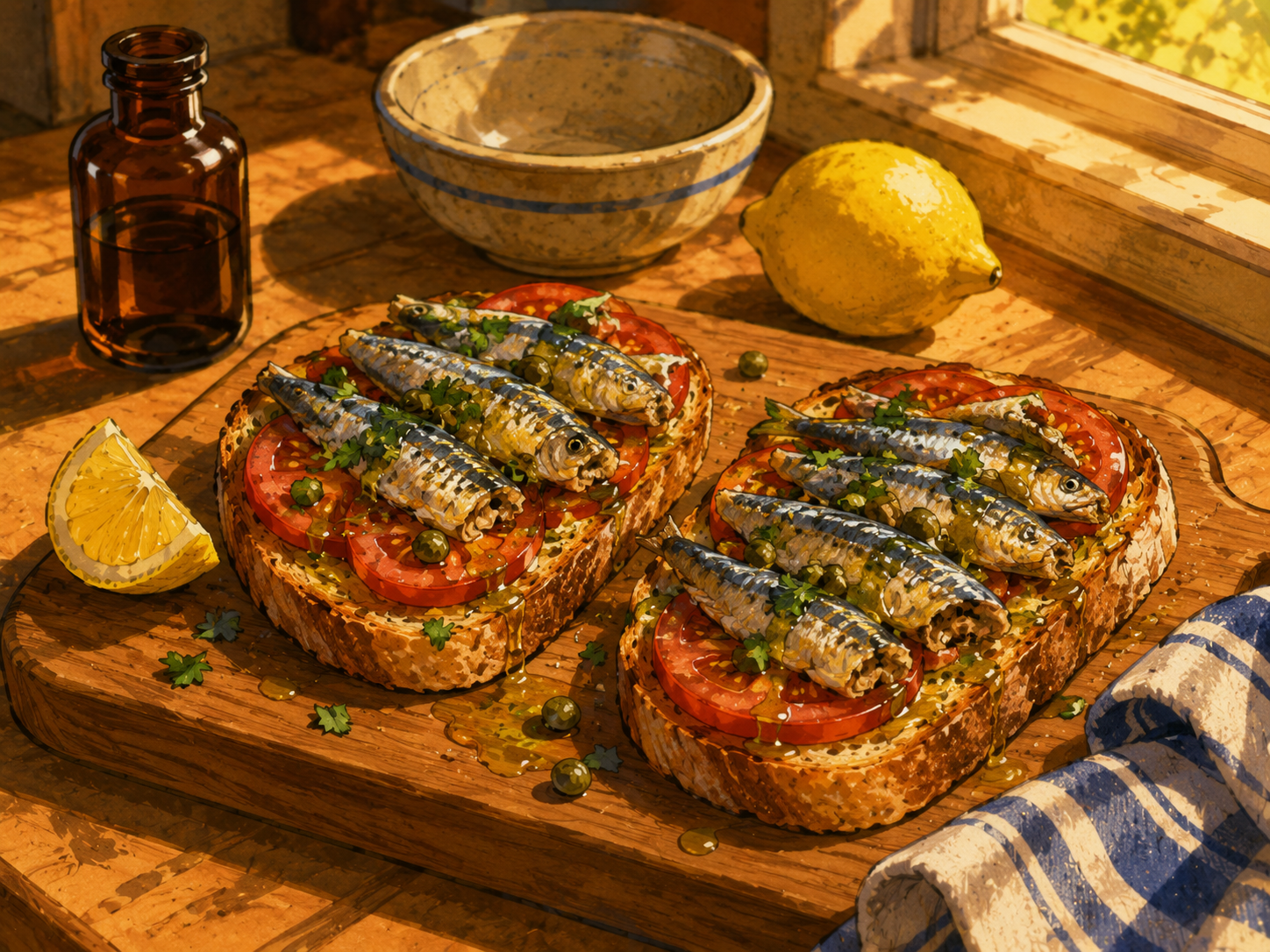
Food first, always. Wild salmon, sardines, mackerel, anchovies, herring. Canned wild sardines and canned wild salmon are nutritionally identical to fresh, and much cheaper. Sardines on sourdough with olive oil and tomato is a full meal that quietly does exactly what a capsule does, and it tastes like something.
Fish oil and blood thinners, briefly. Fish oil has a mild antiplatelet effect, but randomized trials — including in people on aspirin, warfarin, and heart surgery patients — haven't shown a meaningful bleeding jump. Still worth a word with your clinician if you're on an anticoagulant or have surgery coming up. The dose-dependent signal actually worth watching is a small rise in atrial fibrillation above roughly a gram a day, clearest at three to four grams and mostly in people already at high cardiovascular risk. Eating fish doesn't carry the same signal. This is my personal story, not medical advice.
What this whole thing was about
I grew up believing I was allergic to everything, because that is what a specialist wrote on a chart forty-something years ago after scratching my back with a lancet.
I was not allergic to everything. I was a kid with a histamine system turned up loud and a fatty-acid pipeline turned down slow, and nobody in 1978 could see either one of those things because the science did not exist yet in a form a family doctor could hand back to my mother.
The food changed my baseline. The fish oil changed my ceiling. The genetics finally explained why.
The food changed my baseline. The fish oil changed my ceiling. The genetics finally explained why.
Frequently asked questions
Is fish oil actually a supplement, or is it a food?
Fish oil is oil pressed out of fish — the same fatty acids you would get from eating sardines, mackerel, or salmon, just concentrated. It is not a synthetic molecule assembled in a lab. If you eat two to three servings of oily fish a week, you may not need a bottle at all. The bottle is convenience, not chemistry.
Can fish oil help with seasonal allergies or hives?
In my personal experience, yes — but that is my experience, not a prescription. The mechanism has research behind it: DHA is the raw material for a resolvin called Protectin D1, which inhibits mast cell degranulation — meaning less histamine gets released when the mast cell is triggered. It is not an antihistamine. It is one step upstream of one. Talk to your own doctor before making changes.
Why would fish oil work for me when plant omega-3 does not?
Plant omega-3 is ALA — alpha-linolenic acid. The body has to convert ALA into EPA and DHA before it can use them, and that conversion is handled by two enzymes called FADS1 and FADS2. Common variants in those two genes reduce the conversion rate by roughly 30 to 50 percent. If you carry those variants, plant omega-3 arrives at the door but does not fully make it inside. Preformed EPA and DHA from marine sources bypass the conversion step entirely. You can see whether you carry the variants by running your raw DNA through foodZipper.
How much fish oil should I take?
For general purposes, 500 mg to 1 g of combined EPA plus DHA per day is a reasonable starting range for most adults. Two to three servings of oily fish per week gets you there without a bottle. More is not automatically better. Fish oil has a mild antiplatelet effect, but trials haven't shown meaningful bleeding risk even alongside blood thinners — still worth a word with your clinician if you're on an anticoagulant or have surgery coming up. The signal actually worth watching at higher doses is a small rise in atrial fibrillation, clearest above a gram a day. And keep the bottle refrigerated after opening — oxidized fish oil is worse than none.
Keep reading
The Pain Was in My Knees. The Clue Was in My Genes. — bone-on-bone, eight years of bad sleep, and the vitamin D detour that gave me my knees back.
Exercise: The Other Half of the Protocol — for slower MAO-A and COMT patterns, food sets the floor and movement opens the valve.
Back in the Saddle — mountain biking again at 57 with bone-on-bone knees, and the ride that shut my head up.
Why Choose Brussels Sprouts Over Pill-Form Supplements from the Shelf? — the difference between a food and a lab construction, and why it matters.
Research behind this post
Links open in a new tab. Sources listed by topic.
How omega-3 acts on mast cells and histamine
Protectin D1, an omega-3–derived lipid mediator, resolves mast cell–driven allergic inflammation via FcεRⅠ signaling
Biomedicine & Pharmacotherapy, 2025 — the DHA-derived resolvin that inhibits mast cell degranulation
Dietary Omega-3 Fatty Acid Dampens Allergic Rhinitis via Eosinophilic Production of 15-Hydroxyeicosapentaenoic Acid
International Journal of Molecular Sciences, 2019 — the EPA metabolite 15-HEPE and allergic rhinitis
Omega-3 Fatty Acid and Skin Diseases
Frontiers in Immunology — review of EPA/DHA effects on atopic dermatitis and cutaneous inflammation
The Complex Interplay Between Immunonutrition, Mast Cells, and Histamine Signaling
Nutrients — how membrane omega-3 composition changes mast cell reactivity
Supplementation with long chain n-3 fatty acids and risk of asthma and atopic disease
Nutrients — systematic review of the mixed evidence in randomized trials
FADS variants and plant-to-marine omega-3 conversion
FADS1 rs174537 and EPA/DHA — Tanaka et al., PLOS Genetics
The core paper linking FADS1 variation to circulating EPA
FADS2 rs1535 modifies therapeutic response to omega-3
OMEGA-REMODEL trial — FADS2 variants and omega-3 response
FADS genetic variation and omega-3 fatty acid deficiency
Frontiers in Nutrition, 2025 — recent review of the FADS clinical picture
Omega-3, cognition, and anxiety
A systematic review and dose response meta-analysis of Omega-3 supplementation on cognitive function
Scientific Reports, 2025 — 58 studies, significant improvement in attention and perceptual speed at 2 g/day
Efficacy and safety of omega-3 fatty acids supplementation for anxiety symptoms
BMC Psychiatry, 2024 — dose-response meta-analysis of RCTs
Association of Omega-3 Polyunsaturated Fatty Acids With Changes in Severity of Anxiety Symptoms
JAMA Network Open — meta-analysis of clinical trials in anxiety
Change the way you eat. Change the way you feel. That's foodZipper.
— B+
foodZipper is free. Your file never leaves your device. Upload your DNA and see your histamine and FADS panel.