The Pain Was in My Knees. The Clue Was in My Genes.
I moved back from Florida to Michigan in 2012.
By 2013, I could barely walk.
The pain started in my knees and didn't stop. Day, night, on the job, off the job. Sitting hurt. Standing hurt. Getting in and out of the car hurt. Sleep was the worst part — I'd lie there with both knees aching, shoulders catching up, and the kind of bone-deep tired that comes from never actually resting.
I'm a wallpaper hanger. The work happens on a ladder, on your knees, on your toes, reaching, twisting, lifting heavy double rolls, pasting tables, scoring seams, smoothing edges. The body never settles into one position. The knees take more of it than people realize.
The diagnosis
I went to the doctor. They sent me for X-rays. The radiologist's word was osteoarthritis. The orthopedic surgeon's word was bone-on-bone. Both knees. The cartilage that's supposed to cushion the joint was gone, and the bones were grinding against each other every time I moved.
The recommendation was bilateral knee replacements. Eventually. When the pain got bad enough.
I asked the question that mattered most for my life: "Will I be able to kneel after the surgery? For my work?"
The answer I got was the kind of answer a lawyer would give:
"I don't have any restrictions against kneeling."
That's not an answer. That's a sentence designed to not be wrong.
Because the reality is different. I know people in the trades who got knee replacements. Some did fine on a desk. None of them came back to the kind of work that requires kneeling on hardwood floors for hours hanging a stairwell. The trade was over for them. Done. At fifty.
So I started interviewing surgeons. Not waiting for the pain to get worse — looking at who I'd want to do the work, asking what life looked like after, asking about kneeling, asking the questions that mattered to me. Trying to find someone whose answers I could live with.
I didn't find them. I kept working.
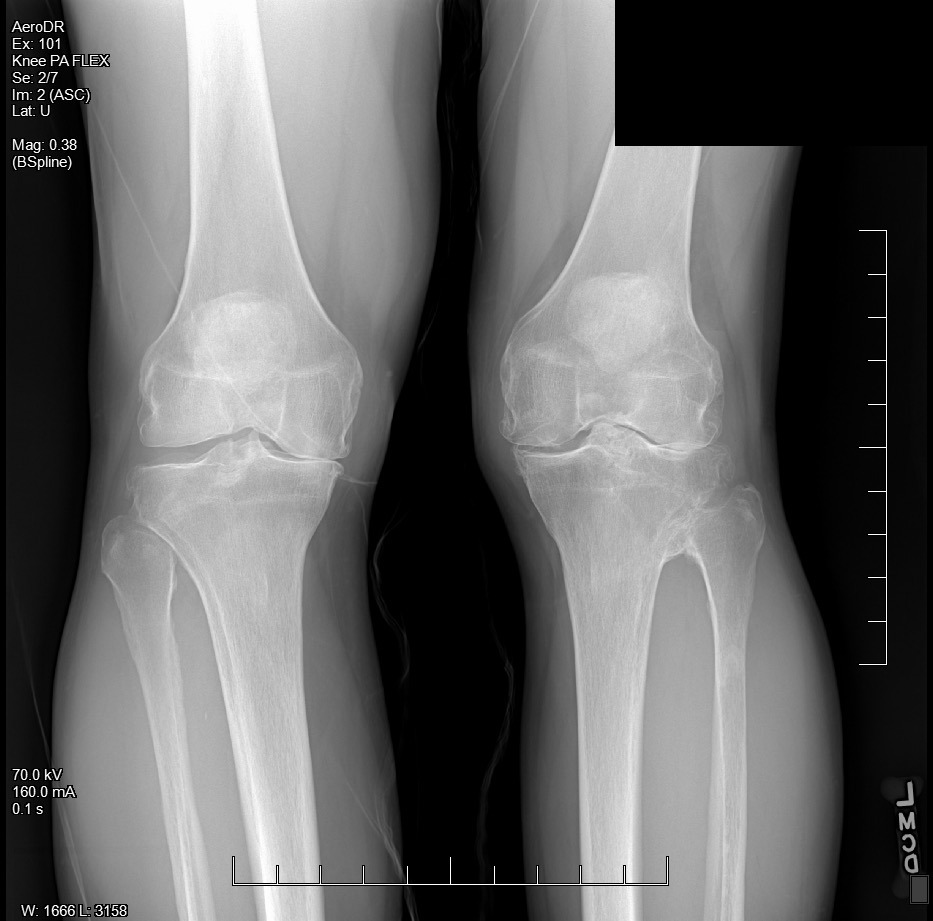
My knees in 2021. Bilateral. Bone-on-bone. The joint space is supposed to be the dark band between the femur and tibia — barely there.
Eight years of bad sleep
From 2013 to about 2020, I lived inside chronic pain.
It wasn't the kind of pain that comes and goes. It was a 9 that never turned off. The constant baseline of something is wrong, every minute, all the time, for years. The kind of pain people picture when they hear "pain" — except it wasn't a flare, it was the floor.
That kind of pain doesn't break you. It just slowly takes pieces.
It takes your sleep, because every time you roll over your knee wakes you up. It takes your patience, because everything is harder than it should be. It takes your morning, because the first hour out of bed is just walking it off. It takes your weekends, because the only thing you want is to not move. And it takes your trust in the medical system, because the only thing they have to offer is "come back when it's bad enough for surgery."
I learned to work through it. Most days I had no choice. The work doesn't stop because your knees hurt. The mortgage doesn't stop. So you get on your knees and you do the work and you go home and you don't sleep.
The accidental detour
Then COVID hit.
Everybody started talking about vitamin D and vitamin C and zinc. Whether any of it would do anything for the virus, who knew. But the chatter was loud enough that I started taking vitamin D. A little at first.
Then I got my level tested. It was low. My doctor and I agreed to bring it up — and to bring it up aggressively, with bloodwork at every step. Over time we got my serum 25(OH)D from low into the 125 ng/mL range — right at the edge of the standard reference range, with my doctor watching every number. We rechecked. We adjusted. We rechecked again. The point wasn't a magic dose. The point was getting the receptor what it needed and not stopping just because the standard chart said most people are fine on much less.
The change wasn't dramatic. It wasn't a movie scene. It was slow. Months. Then a year. Then two.
Somewhere in there, I noticed I was sleeping again.
Then I noticed I could get into the car without grimacing.
Then I noticed the morning hour was shorter. Then it was gone.
By 2024 my knee pain had dropped from a constant 9 to maybe an occasional 3. I'm not running marathons. I can't jump. But the inflammation was gone. I could work. I could kneel. I could sleep through the night.
What foodZipper showed me, years after the relief
I built foodZipper for a different reason. Then I ran my own DNA through it.
And there it was. Right there in the report.
The vitamin D receptor — VDR — is what your cells use to actually do something with the vitamin D in your blood. Calcium absorption. Bone remodeling. Inflammation regulation. Even pain modulation. The receptor is the translator between the nutrient and the effect.
Variants in the VDR gene — Taq, Bsm, Fok, Apa — change how efficiently that receptor works. People with reduced-efficiency variants tend to need more vitamin D to get the same effect as someone with the standard variant. There's growing research linking VDR variants to osteoarthritis severity, lower bone density, and inflammatory response. The science is still emerging, and not every paper agrees on every detail. But the direction is consistent enough that it's worth paying attention to.
Looking at my own report: VDR Taq +/+. Homozygous. Both copies of the variant.
A walkthrough of what's happening at the receptor · sound on
Which means: standard vitamin D advice, sized for the average receptor, was probably never going to be enough for me. The 600 IU a day RDA, the multivitamin sprinkle, the "get a few minutes of sun" advice — none of it was going to move the needle on my system. With a less-efficient receptor, I needed more circulating D for the same downstream signal. And I needed it consistently, with my doctor watching the bloodwork the whole way.
I didn't know any of that in 2020. I was just lucky enough to have stumbled into doing the right thing for long enough.
And then the food layer arrived
Here's where it got interesting.
Once I built foodZipper and saw my full report — not just the VDR but everything — I started bringing in the foods. Not just vitamin D. The whole protocol.
Mushrooms grown in sunlight, for natural D2. Salmon and sardines for D3 and omega-3s. Eggs from pastured hens. Leafy greens for magnesium and K1. Hard cheeses and natto for K2 — the cofactor that tells calcium where to go (into bone, not into soft tissue). Pumpkin seeds for the magnesium my MAO-A pathway also wants. Spinach for folate. Real B12 from animal protein. The whole stack, working together.
And here's the part that surprised me.
I feel better today than I did three years ago. Better than I have in a decade. The supplement got me out of the hole. The food layer is what closed the gap.
Vitamin D doesn't work alone. It works with K2, with magnesium, with the cofactors and the matrix that real food provides and a pill never quite does. The supplement was the rescue. The food was the maintenance. And the maintenance is where the system actually rebuilds itself.
What I think this means for other people in trades
I've worked alongside trade guys for thirty years. Wallpaper, paint, floor, tile, drywall. Some of them never had knee problems. Same kneeling, same long days. But they don't ache. They don't limp.
And then there are guys like me, who break down by their forties. Same job. Different bodies.
I'd bet a lot of money that the difference is partly genetic. Some of us have VDR variants that mean our bodies don't use vitamin D as efficiently — which means our cartilage doesn't get the same support, our inflammation doesn't get regulated as well, and the wear and tear of the work hits harder than it should. Some of us probably also have COMT and MAO-A variants on top of that, which is why the pain felt so loud at night and why we couldn't shut it off.
It's not all genetic. Diet, sleep, alcohol, weight, the actual physical demands of the job — all of it stacks. But genetics is one of the layers, and until recently nobody could see it.
What I'd tell my 2013 self
Look at your DNA before you let anyone schedule a surgery you can't undo.
Get your vitamin D level tested. The actual blood number — 25(OH)D. Most labs run it for around $50. Talk to your doctor about where that number is and where it should be for your situation.
If your level is low and you have a VDR variant, the food layer matters more than you think. Salmon and sardines for D3. Mushrooms grown in sunlight for D2. Eggs from pastured hens. Pair it with K2 from natto, hard cheeses, or pastured egg yolks. Pair it with magnesium from greens, nuts, seeds. The cofactors matter as much as the D itself.
And give it time. Vitamin D doesn't work overnight. It works on the timescale of bone, which is months and years. You're rebuilding a system, not popping a painkiller.
I'm not saying vitamin D fixed my arthritis. The X-ray hasn't changed — bone-on-bone is still bone-on-bone. What changed is the inflammation, the pain, the sleep, the ability to keep working. The structural damage is still there. The biochemistry around it is finally cooperating.
Important. This is my personal story, not medical advice. If you're considering changes, always consult your clinician.
If you've been told you'll need a knee replacement someday, that's a conversation between you and your surgeon. Don't take medical advice from a blog. But before you let it happen, look at your variants. Look at your nutrient status. Try the food layer for a year. See what changes.
That's all I'm saying.
That's the whole post.
Published research cited in this post
Proper Calcium Use: Vitamin K2 as a Promoter of Bone and Cardiovascular Health — PMC
Change the way you eat. Change the way you feel. That's foodZipper.
— B+
foodZipper is free. Your file never leaves your device. Upload your DNA and see your VDR.