Back in the Saddle
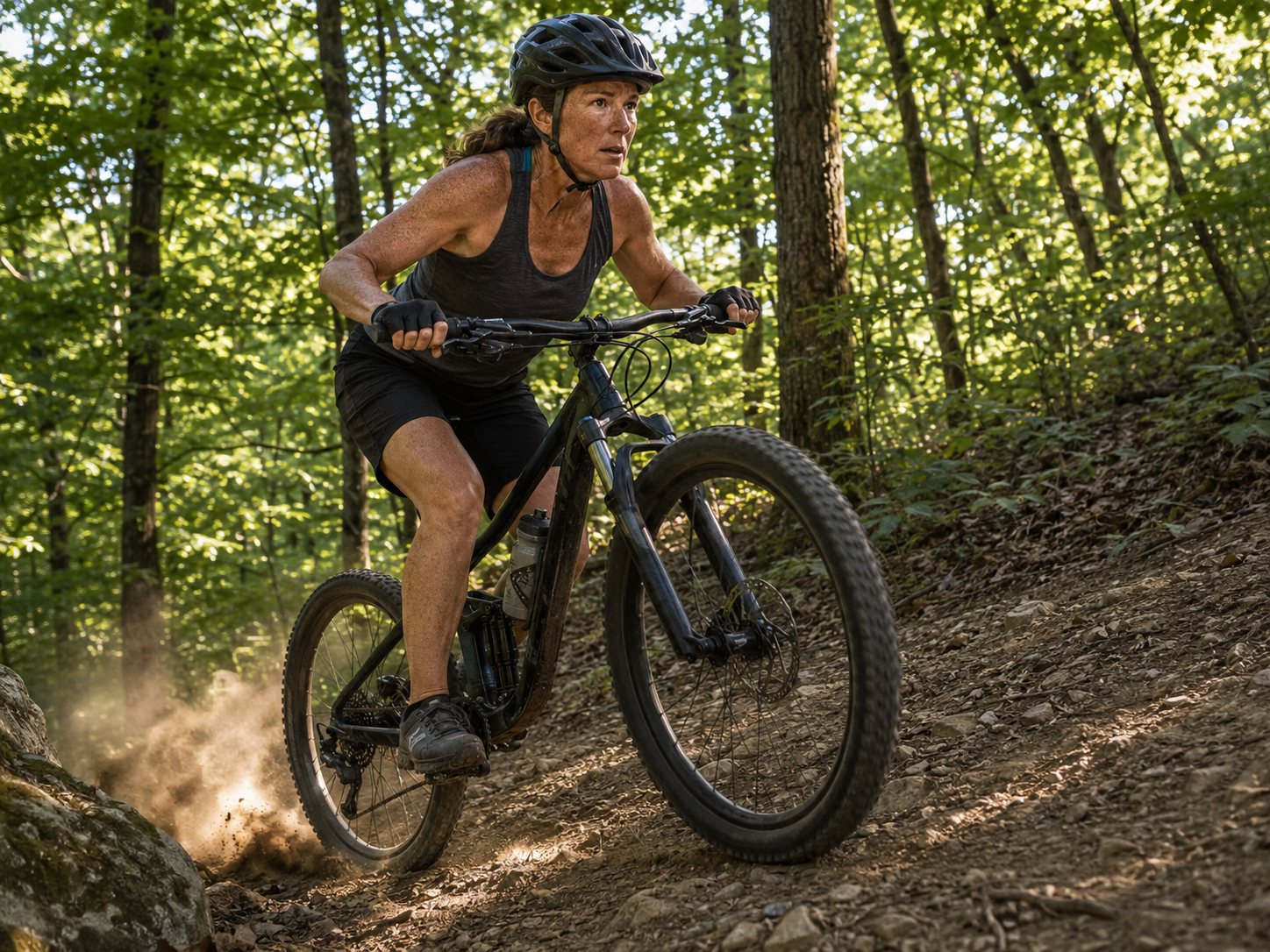
I almost said no.
My neighbor asked if I wanted to come ride some trails and throw a little frisbee golf. The first thing that came up was, oh, man. Not today. I hadn't been on a bike in six, maybe seven years. Both my knees are bone-on-bone. I'm fifty-seven. The reflex of someone who's spent a decade managing pain is to guard the part that hurts. Stay home. Don't risk it.
I said yes anyway. I still don't entirely know why. And it turned into one of the best days I've had in years.
A bike that sat in the garage
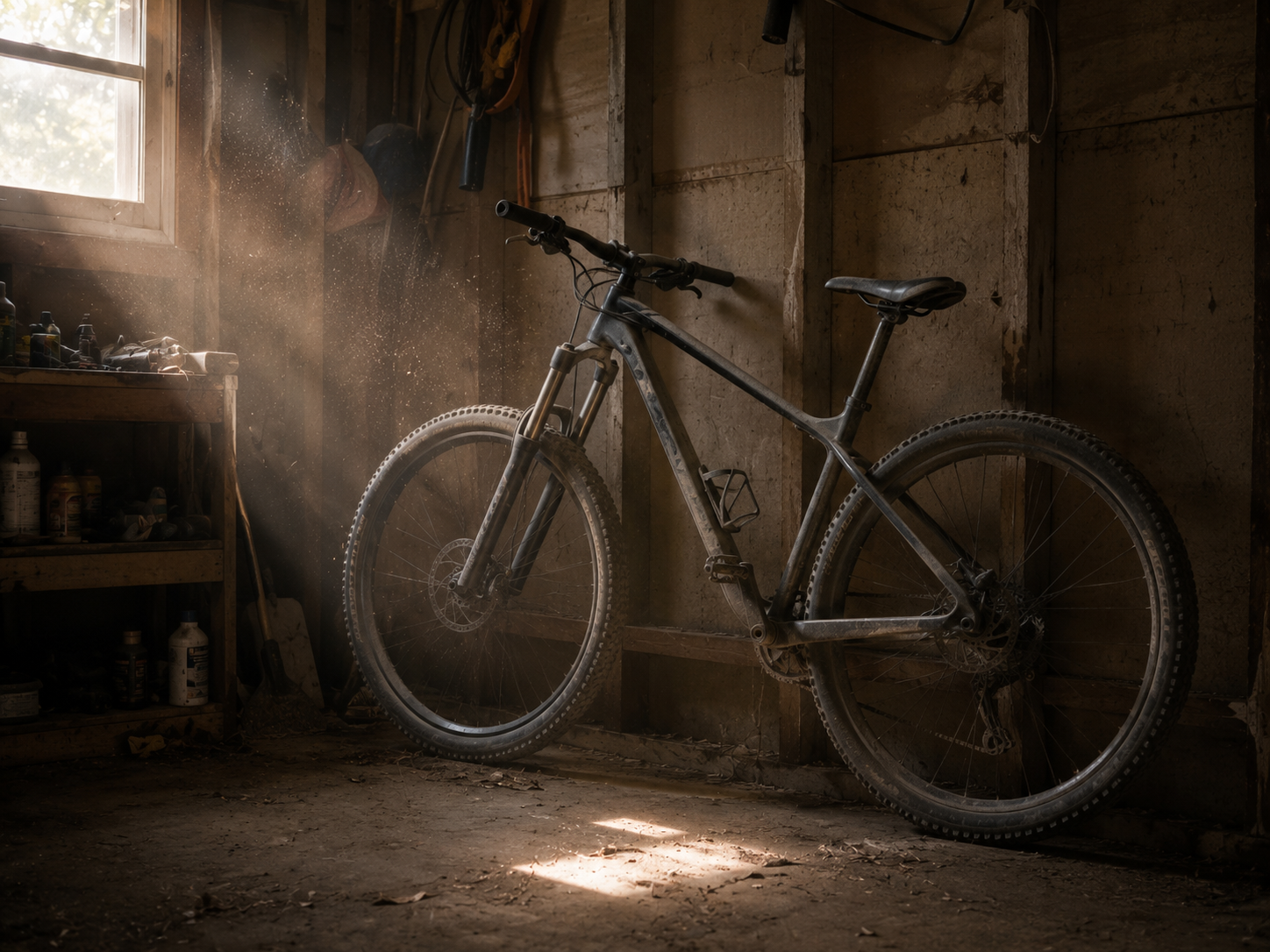
Back in 2019 I bought a Ghost Kato 6 — a hardtail mountain bike, nothing fancy, a good honest bike. I rode it a little while. Then my arthritis got worse, and worse, until the Kato ended up in the garage gathering dust because my body couldn't cash the check anymore.
The e-bike that didn't quite do it
So I did what a lot of people my age do when the joints give out: I bought an e-bike. I'll leave the brand out of it. It was heavy, it was genuinely fun, and I'll give it credit — it got me outside and moving. But the motor does the work, and what I was actually missing was the feeling of my own body doing something. The burn. The effort. The proof that I'm still in here. Back then, with my arthritis at full volume, that combination — muscles working without my joints paying the price for it — just wasn't on the menu. Push hard enough to feel my legs, and my knees made me pay for days.
So the e-bike did its job, and then it sat too, until the battery died. I finally bought it a new battery — and now I'm selling it, barely used, to someone who'll get more out of it than I did.
I could have blown it off — easily
And I want to be honest about how close I came to missing it. If my neighbor had texted that morning — hey, mind if we cancel? — I'd have said sure, no problem, next time before he finished the sentence, and gone right back inside. Back to the comfort zone. Back to the isolation that feels safe and quietly eats you. Back to turning the same thoughts over and over — the ones I can't fix, the loops that run at night.
That's the gravity. It's always pulling you toward the chair. The only reason I got off it that day is that nobody handed me an out.
Helmet on, and go
The bike I took wasn't even mine anymore. It was that same Ghost Kato 6 — the one I'd handed down to my son. It was sitting in the garage, so I pulled it out, dusted it off, and put a helmet on. Safety first, every single time — I don't care how short the ride is, the helmet goes on. Then we rolled out.
The first mile was awful — and that was the point
I'll say it again because it matters: nobody warns you about the first mile.
My hands were vibrating on the bars. Every root and every rock came straight up through the frame and into my palms, my wrists, my shoulders. Oh no. This is terrible. This is awful. My body had forgotten how to do this.
But here's the thing I didn't expect. That little bit of pain and discomfort took me out of myself. All that vibrating, all that effort — it left no room for the worry. I stopped thinking about the things I can't control — the loops, the what-ifs, all of it. The discomfort was actually doing something for me. And down the trail we went.
A park I'd never seen, ten minutes from home
We clipped our lights on, with miles still to go, and we ended up at a park I had never once set foot in — even though I've lived near it my entire life. Fifty-some years, right there, and I'd never been. It was hilly. Little descents that made my stomach drop. Trails winding through the trees. Scenery I had no idea was sitting in my own backyard.
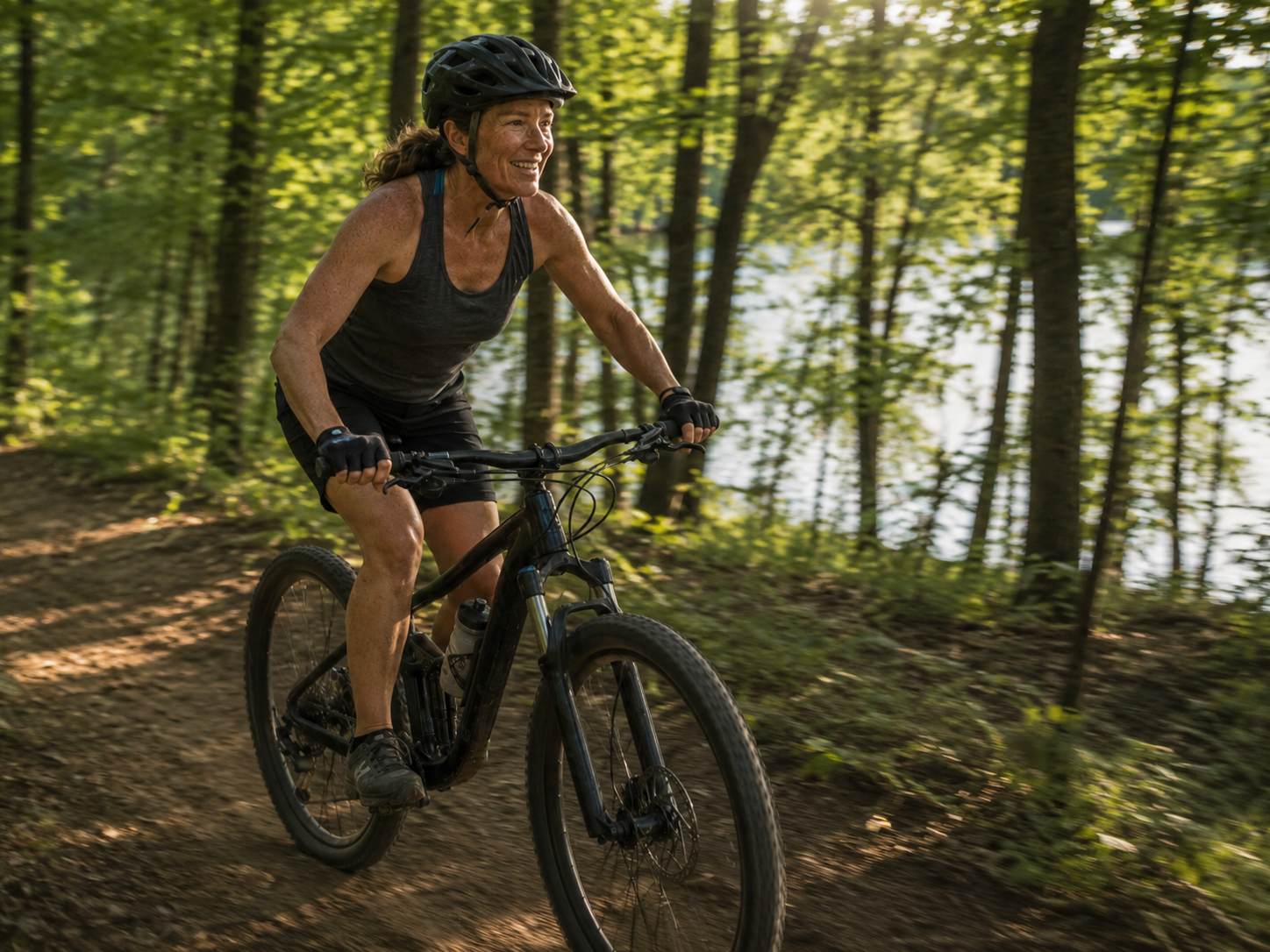
And somewhere in there, I forgot about all of it. The stuff I'd been so wound up about earlier just... wasn't there. I was in the moment.
Being in the moment is a rare thing — away from the screen, away from the calls, away from the worry that runs all day. That morning I was just there. And I felt like a kid again, on a sunny Saturday.
Frisbee golf, and letting go of an old ego
We played frisbee golf, too. Never done it in my life. It was a blast.
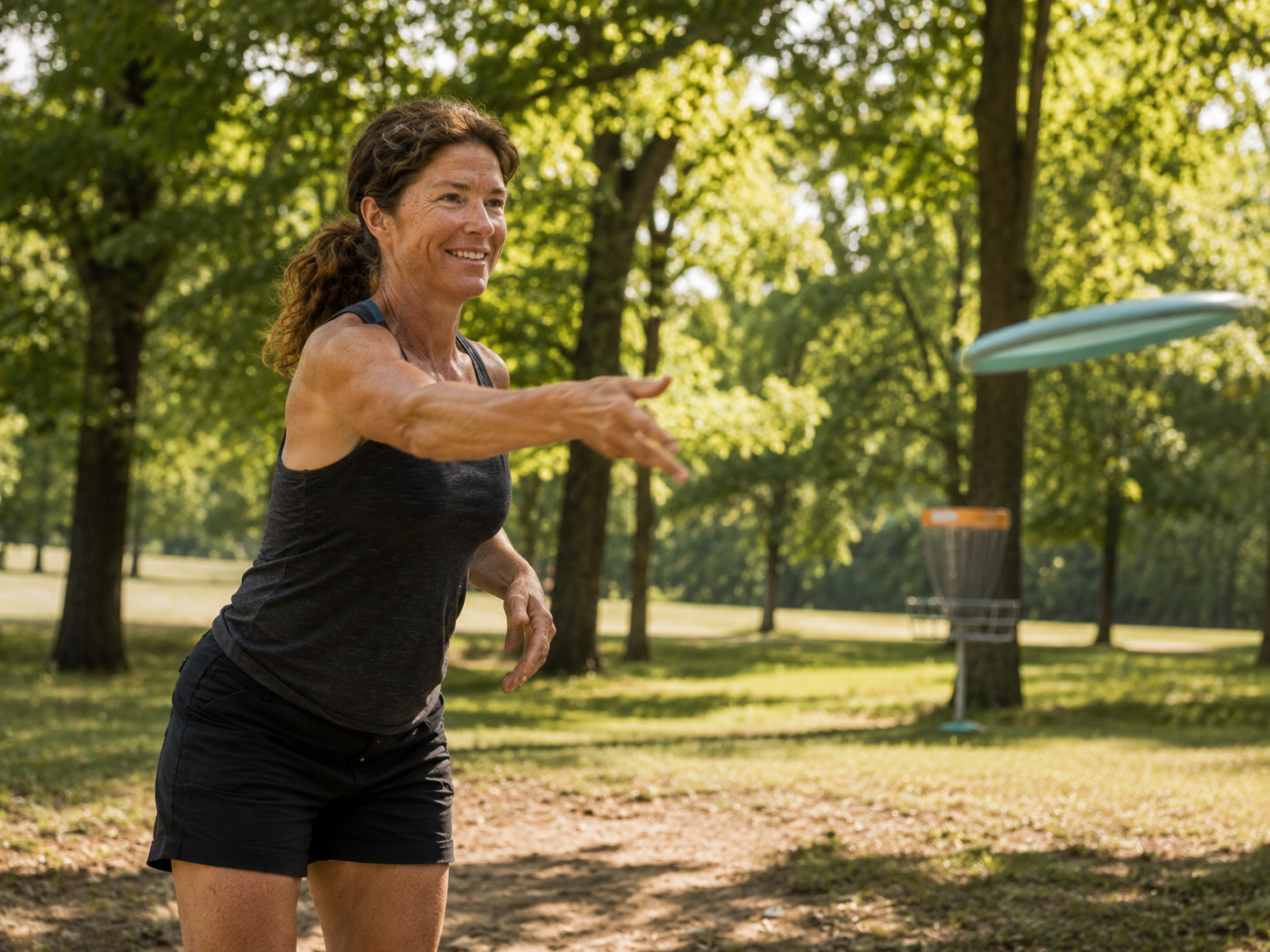
And I found out something. My shoulders — which, like everything else, I'd been quietly worried about — could still throw. Not two hundred yards. Not like some younger version of me might have wanted. But enough to play, enough to laugh, enough to have fun. And I realized I didn't care about the old ego anymore. There's a freedom in doing something badly and enjoying it anyway. I think I'd forgotten that.
I overdid it, and I'll own that
Here's the dumb part, because it wouldn't be an honest post without it.
It was almost a hundred degrees. Michigan, in the thick of summer. By the time I was heading home I felt like I was going to throw up — that hot, hollow, sick feeling. I barely made it back. That wasn't toughness. That was me not respecting the heat and not drinking enough, on a body that hadn't done this in seven years.
So if you're getting back into it: ride the cool part of the day, carry more water than you think you need, and make I feel good tomorrow the goal instead of how hard can I push today. I got lucky. Don't count on luck.
The next morning is what sold me
I got home, drank my fluids, took a shower, and laid down in the cool air until my body came back down.
And the next morning — nothing. No soreness. I got out of bed and my legs felt good. They felt like they could move.
This is the part that closed it for me. On the e-bike, I never felt my muscles work. This time, I did. My thighs had burned on that climb, and the next morning they felt used — alive — but my knees didn't punish me for it. That's the exact thing I'd been missing for years: the thing the e-bike couldn't give me, and the thing my arthritis wouldn't allow. The muscle without the joint tax. For the first time in a long time, I got to have both.
I ran marathons once, another life ago, and for a second there I actually thought: maybe I could run. I can't. My knees are done with that. But I can bike. And right now, at fifty-seven, that's just about everything.
Why this was even possible
None of this would have been on the table a few years ago.
From about 2013 to 2020 I lived inside a level of knee pain that didn't turn off. Bone-on-bone, both sides, the kind of thing they want to fix with replacements. I told the whole story here — the short version is that getting my vitamin D up, slowly and under a doctor's eye, along with changing how I eat, dropped my pain from a constant 9 to an occasional 3. The X-ray hasn't changed. Bone-on-bone is still bone-on-bone. But the inflammation quieted down enough that I could sleep, and work, and — it turns out — get back on a bike and actually feel my legs again.
The structure is still damaged. The life around it finally started cooperating. That's the difference between a scan and a person.
What a bike can't tell you — but your DNA can
I bought the new bike online — a Canyon Neuron 5. I'd read good things, it was on sale, and it reminded me of the Ghost I already liked.
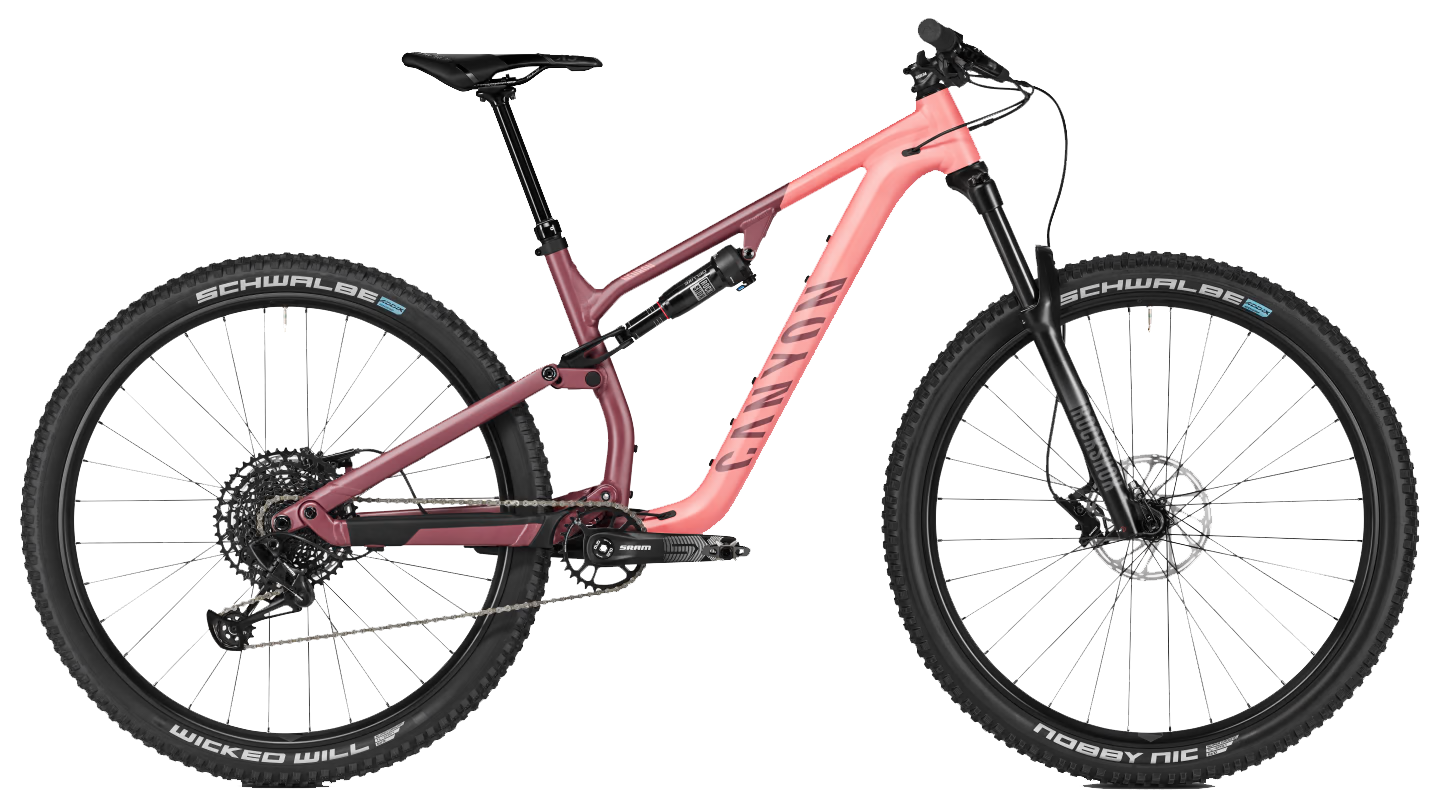
You can't really know whether a bike fits you from someone else's review, anyway — you only know once you've put the miles in and felt it. And Canyon gives you a thirty-day trial period, as long as the bike comes back clean and in like-new condition, so I'm not going to lose any sleep over it.
That said — here's one of the reviews I watched before I bought it.
With food, though, it doesn't have to be a guessing game.
That's what I love about foodZipper: you don't have to borrow anybody else's opinion, because your own DNA is already telling you which foods fit you. It's already written down inside you. My MTHFR variant means I lean on folate — so, Brussels sprouts, asparagus, cooked spinach (go easy on the spinach if you're prone to oxalate trouble). My MAO-A pattern points me toward magnesium — pumpkin seeds, sunflower seeds, sesame seeds. The little snacks I make with a bit of honey and some dark chocolate chips. foodZipper didn't invent any of that. It just read what was already in me and handed me the list.
And I believe it's a big part of how I got here — not because it fixed the structure of my knees (nothing did; bone-on-bone is still bone-on-bone), but because it helped me feed the biology around the damage. That was the food doing its half.
The food made the bike possible. But the bike did something food alone never could. Now I have to do my half.
The other half of the protocol
The MAO-A, the COMT, and an MTHFR variant run strong through my family — you can trace them through the generations. And they seem to hit us hardest in the adolescent and early-adult years, right through puberty. I've written about my own version of that here. It isn't a character flaw. It's a clearance rate.
Food sets the floor. But for a pattern like mine, food is only half of it. Movement is the other half — I got into the why of that here. And I can tell you first-hand, not as theory: the sweat, the pushing through the discomfort, it cleared me. I felt reborn. New. Whatever had been sitting on me before was gone.
I already knew this at thirty-three
The strange part is, I'm not discovering something new. I'm remembering something I already knew.
Back in my early thirties, I had a protocol of my own — not because a report told me to, but because it simply felt right. It felt good. I ran almost every day, five or six days a week, and I had a routine. I'd go to work and bring my own food: healthy snacks, nuts and seeds, fresh fruit, some fish. And when I finished up, usually around three, I already had a bag packed with my running shorts and shoes.
I'd drive out to Stoney Creek, change into my running clothes, and sit on a bench overlooking the lake to stretch and get ready before I set off — three miles some days, six, sometimes twelve.
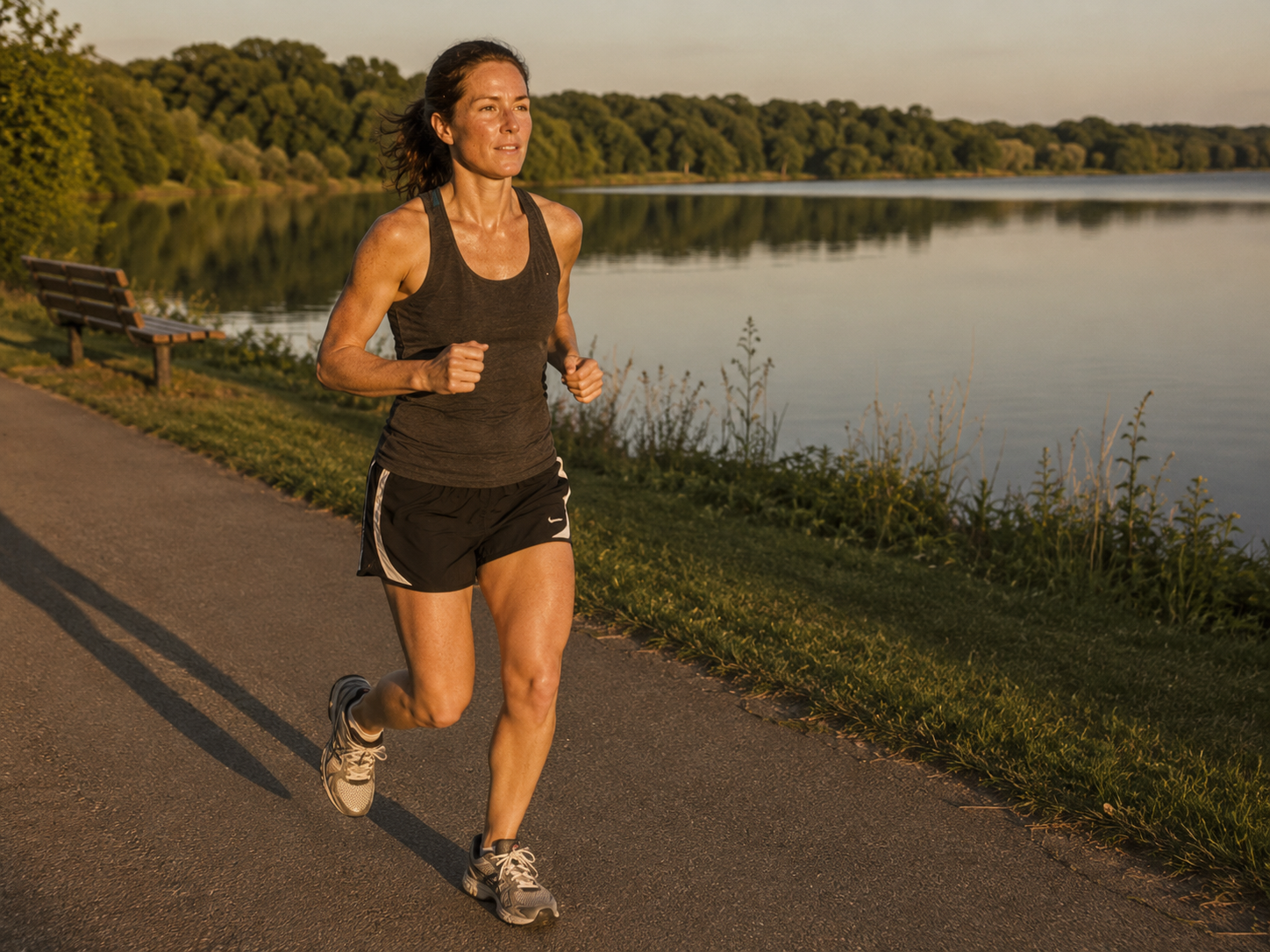
And it felt exactly like it felt getting off that bike the other day.
You come back and you can hear your own breath. Whatever thoughts had consumed you, whatever tangles you'd been carrying around in your head — gone. You're just there. Breathing. You watch a drop of sweat fall from your forehead onto the dry pavement and spread out to about the size of a quarter, and then another, until they start making a pattern — and a moment later the heat coming off the concrete pulls it all back up and it's gone. You look up into the clouds and the blue sky. And there's nothing there but the present. No looping thoughts. No worries. No past. No what could be better. Just this.
What yoga taught me about the edge
Around that same time, I took a couple of yoga classes, too — mostly just to stretch. No pun intended.
But I walked away with one idea that stuck with me for the rest of my life. Always stay within your breath. Stretch a little past your comfort zone, sure — reach for the edge — but only to the edge of your breath. The moment you're breathing too hard, you've gone too far, so pull it back. That's the whole practice. Live right at that line, and let the line move on its own over time.
I didn't know it then, but that one idea would end up governing how I do everything that's good for me. Running, back then. The bike, now. Go to the edge. Not past it.
The watch I gave away
Here's a story that tells you everything about how I ended up thinking about all of this.
When I first got into running, I did what everybody does — I bought the stuff. The shoes, the shorts, the wick-dry shirts. And that's fine; the gear is part of the motivation, part of the fun. And believe it or not, there was online shopping even back then. So I researched the best running watches and bought some sophisticated one — I couldn't tell you the name now — sometime in the late 2000s.
I put it on. Set the timer. Ran. And every step of that run, my whole focus was on the watch. Then I'd finish and think, well, that wasn't the time I should have run that in. After about a week, I was writing it down. Here's what I did. Here's what I should have done.
And one day I stopped and thought: this is horrible. I'm doing something that's healthy for me, and I've turned it into school. Hit your marks. Beat your number. I'm not a professional. I want to enjoy myself. Why on earth should I feel bad about doing something that's good for me?
So I took the watch off and gave it to someone here who ran. They loved it — it was right for them. And I started running with nothing. No watch. No headphones. No music. I wanted to feel it.
And that's when the real thing happened. I'd start a run with all the noise — the dialogue in my head, me and other people, the stuff that was bothering me, the same scenarios playing out over and over. But by mile two or three, the chatter would start to settle. And by mile four, five, six — it was completely gone. All of it just parted away, like it had never been there.
That's the whole reason I'm chasing this again. Not a number on a screen — that feeling. I had it figured out at thirty-something, on instinct. I'm just finding my way back to it now, on new terms.
Why I keep going back out
I'll be straight about the other reason I keep going back out.
I spend too much time in my own head. The looping thoughts. The scenarios that play out over and over. The worry that won't quiet down. I know that place well, because I live there — and I've written about the biology of it, about why my particular wiring holds onto all of it longer than it should. Here's what I learned the hard way: you don't think your way out of a place like that. You sweat your way out of it. Or somebody invites you out of it.
A neighbor knocked on my door and asked me to come ride. He didn't lecture me. He didn't tell me I needed to get out more. He asked me to come throw some frisbee golf. And I went, and it changed my week.
Now I want to be that knock for someone else. Come ride with me. That's the whole speech — there isn't one. Side by side, both of us too winded halfway up a hill to say much of anything. Some of the best conversations a person ever has happen right there, without a single word.
Committing
So that's where I am. Late fifties, a body with some restrictions, and an exercise that's finally mine again — the bike. The new one's on its way. I don't know for certain that I'll love it. I didn't love the e-bike. But the main thing isn't certainty. The main thing is committing: getting on, doing the miles, feeling it for myself, and being willing to change course if it turns out to be wrong.
I have to come out of my comfort zone. I have to ride to the edge of my breath — and, like yoga taught me, know when to pull it back.
I almost said no. I'm so glad I said yes.
Namaste.
This is my personal story, not medical advice. Bone-on-bone arthritis, big jumps in activity, and anything involving vitamin D are all conversations to have with your own doctor — especially if you're coming back to exercise after a long time off. Start easy, and start with your clinician.
Frequently asked questions
Can you mountain bike with bone-on-bone knees?
I do — but I'm one person, and this isn't medical advice. For me, two things made it possible: I got the inflammation around the joint down first, which took years and a doctor watching my bloodwork, and cycling is low-impact, so it spares my knees the pounding that running would deliver. The X-ray is unchanged; what changed is the pain and the inflammation. If you're considering it, talk to your own doctor first.
Is an e-bike or a regular bike better for bad joints?
It depends on what you're after. An e-bike is easier on the joints and gets you outside and moving with far less effort — for a lot of people, that's exactly right. But the motor does the work, so you don't feel your own muscles working. I wanted that effort back, and once my knee pain came down, a regular bike gave me the muscle work without the joint penalty. Neither is "better" in the abstract; it comes down to your goals and your joints.
How do you get back into cycling after years off?
Start smaller than your ego wants. Ride the cool part of the day, carry more water than you think you need, and always wear a helmet. Let "I feel good tomorrow" be the goal instead of "how hard can I push today." My first mile felt awful and I nearly overheated on a hundred-degree day — go easier than I did.
Does exercise really quiet a racing mind?
In my experience, yes — though that's my experience, not a prescription. When I'm working hard enough, there's no room left for the rumination. On my old runs, the chatter would settle by mile two or three and be gone by four or five. I wrote about why that happens, and the gene side of it, in my post on exercise and the MAO-A and COMT pattern.
Keep reading
The Pain Was in My Knees. The Clue Was in My Genes. — bone-on-bone, eight years of bad sleep, and the vitamin D detour that gave me my knees back.
Exercise: The Other Half of the Protocol — for slower MAO-A and COMT patterns, food sets the floor and movement opens the valve.
Why Was Puberty So Difficult for Me? — divorce, genetics, and the brain chemistry that runs through my family.
Research behind this post
Links open in a new tab. Sources listed by topic.
Vitamin D, inflammation, and arthritis
Can diet improve arthritis symptoms?
Harvard Health Publishing — Brigham and Women's Hospital, a Harvard affiliated hospital
Vitamin D and sunlight exposure are associated with reduced knee cartilage loss
Johns Hopkins Arthritis Center — Johns Hopkins Medicine
Vitamin D reduced rate of autoimmune diseases by 22%
The Harvard Gazette — Brigham and Women's Hospital, on the VITAL randomized controlled trial (BMJ, 2022)
Vitamin D: Fact Sheet for Health Professionals
Office of Dietary Supplements — National Institutes of Health (NIH)
Movement, and the MAO-A and COMT clearance pattern
Working off depression — how exercise alters serotonin, norepinephrine, and endorphins
Harvard Health Publishing — Harvard Medical School
Depression and anxiety: Exercise eases symptoms
Mayo Clinic
MAOA gene — how the enzyme clears serotonin and norepinephrine
MedlinePlus Genetics — U.S. National Library of Medicine (NIH)
COMT gene — how the enzyme clears dopamine and other catecholamines
MedlinePlus Genetics — U.S. National Library of Medicine (NIH)
Effect of exercise for depression: systematic review and network meta-analysis of randomised controlled trials
Noetel M et al. — The BMJ, 2024
Change the way you eat. Change the way you feel. That's foodZipper.
— B+