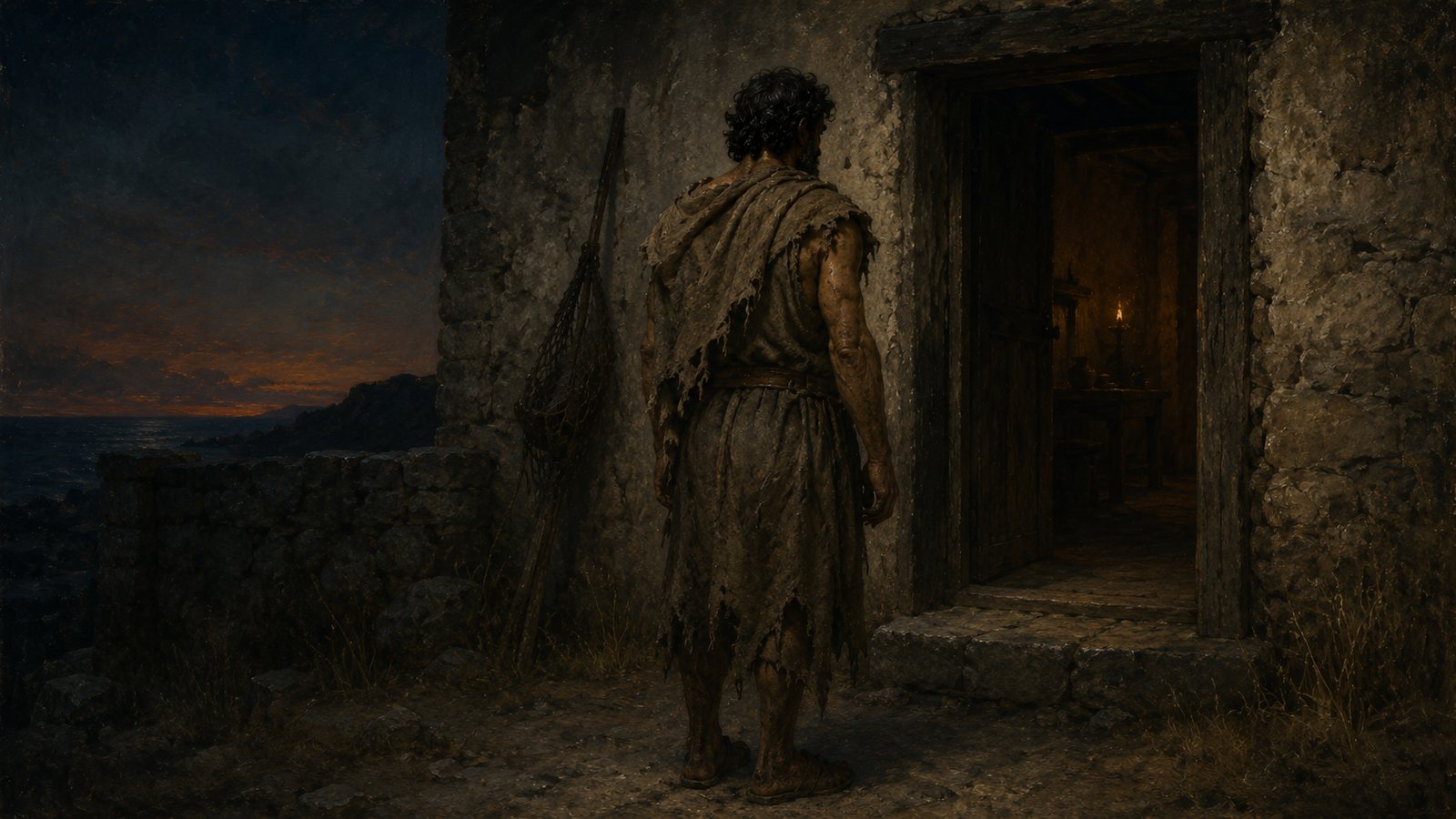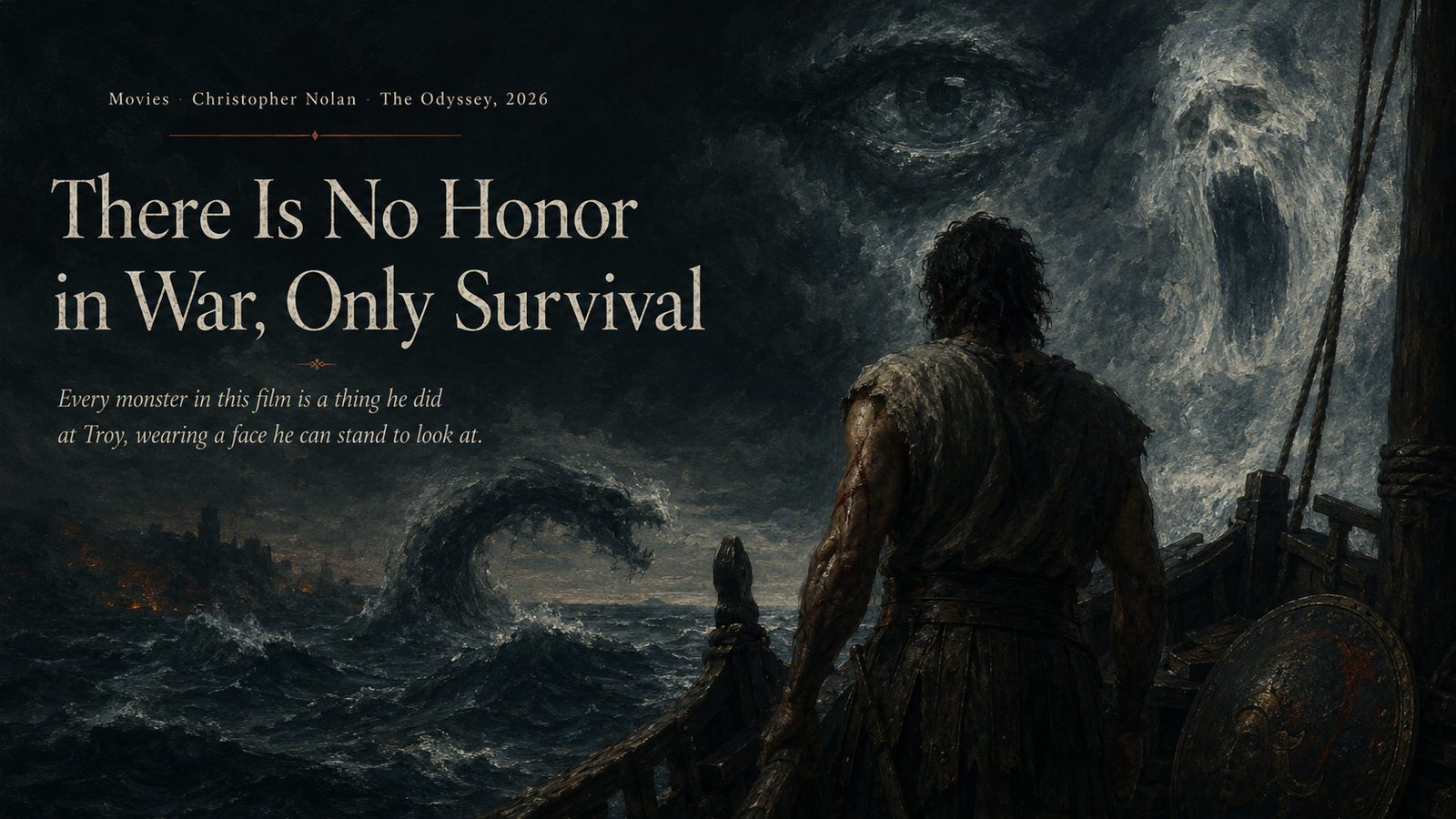
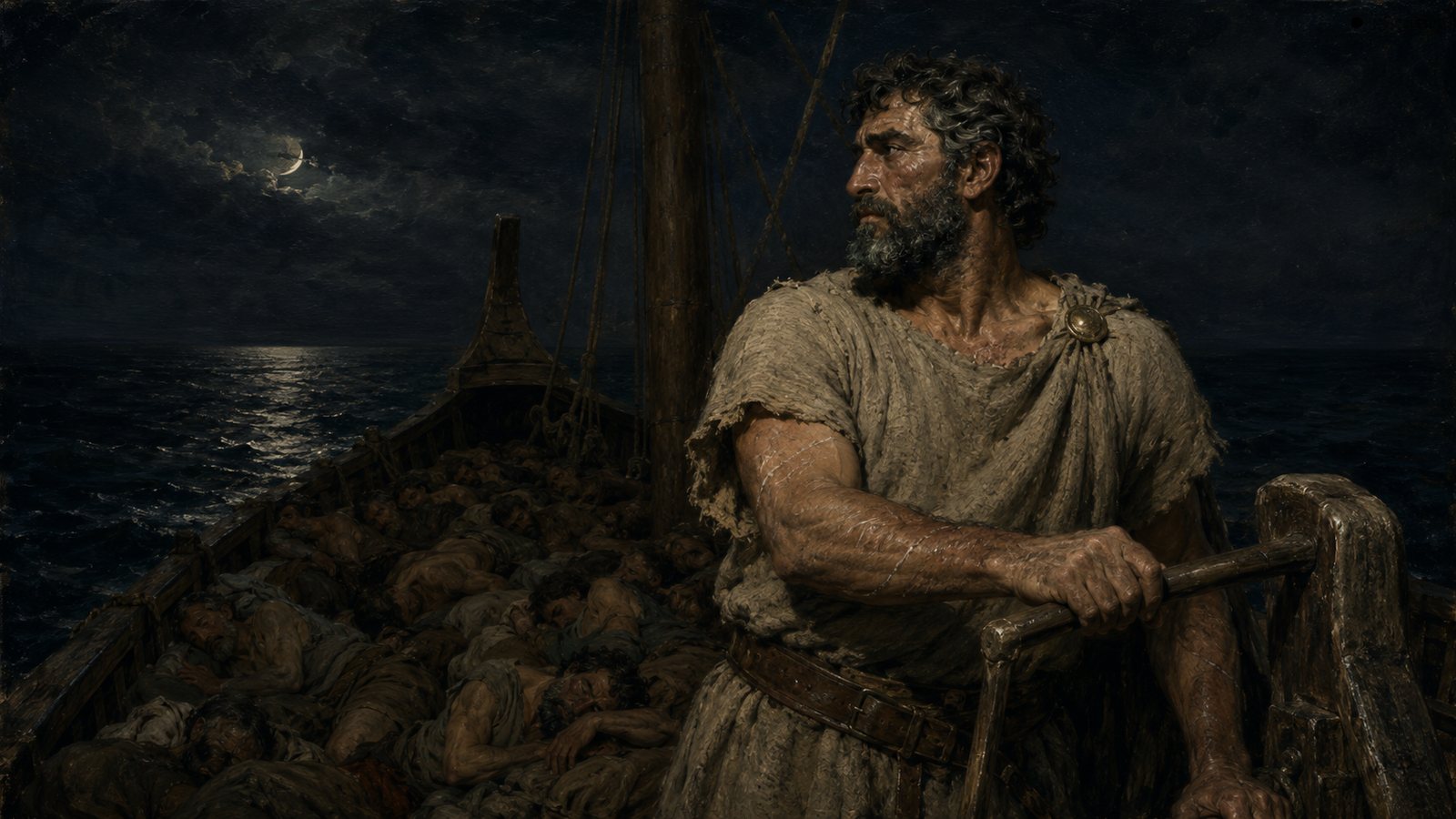
Twenty years. Ten at Troy, ten trying to get back. What fills the second ten is monsters — a cyclops, a whirlpool, women singing on a rock, a witch, giants. Then, at the very end, a woman asks him whether he remembers, and the film finally shows us Troy. The sack. The horror arriving in his face. And only then does he go home.
That ordering isn't a stylistic flourish. It's the entire argument.
Nothing is hidden from you
This works the way The Sixth Sense works. Not by concealing anything — by letting you supply the wrong assumption about what you're looking at. A magic trick doesn't beat your eyes, it beats your expectations. Everything you need is on screen the whole time. You just came in believing you were watching an adventure.
Which is also why the monsters had to be shot as real. If they'd been staged as hallucinations, there'd be no trick — just a diagnosis with a runtime.
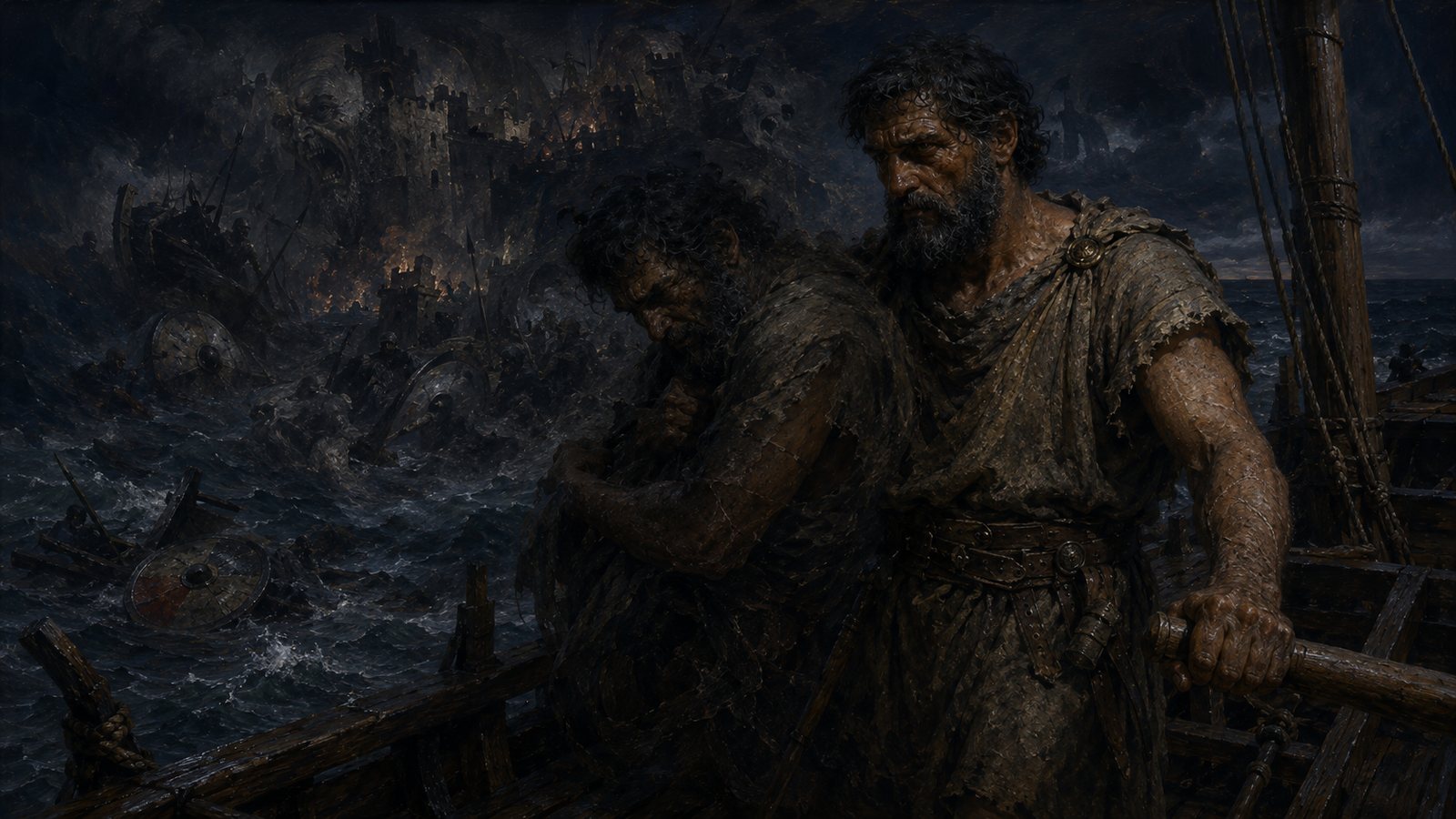
What happened to him was splitting
Not the clinical shorthand the word has become — the all-good, all-bad seesaw. I mean the older thing. Janet was describing it before 1900, and Freud was still writing about it at the end of his life in a paper titled, plainly, Splitting of the Ego in the Process of Defence. Consciousness divides itself in order to survive what it is holding. It happens in people who have been abused or lived through trauma. It happens in soldiers.
One part carries the unbearable thing. The other part is permitted to keep functioning — keep giving orders, keep believing it belongs to the kind of man who could still walk back into his own house.
That's the mechanism. The man on the ship isn't lying to us. He is the part that was spared.
So the war comes back in the only form it can take. Not because he's mad, and not because none of it happened, but because the fantastic is the register trauma gets narrated in when the literal is foreclosed. A memory that can't be approached directly gets recoded until it can be told out loud.
odysseus-splitting-dissociation-troy-burning.jpgThe gift was the crime
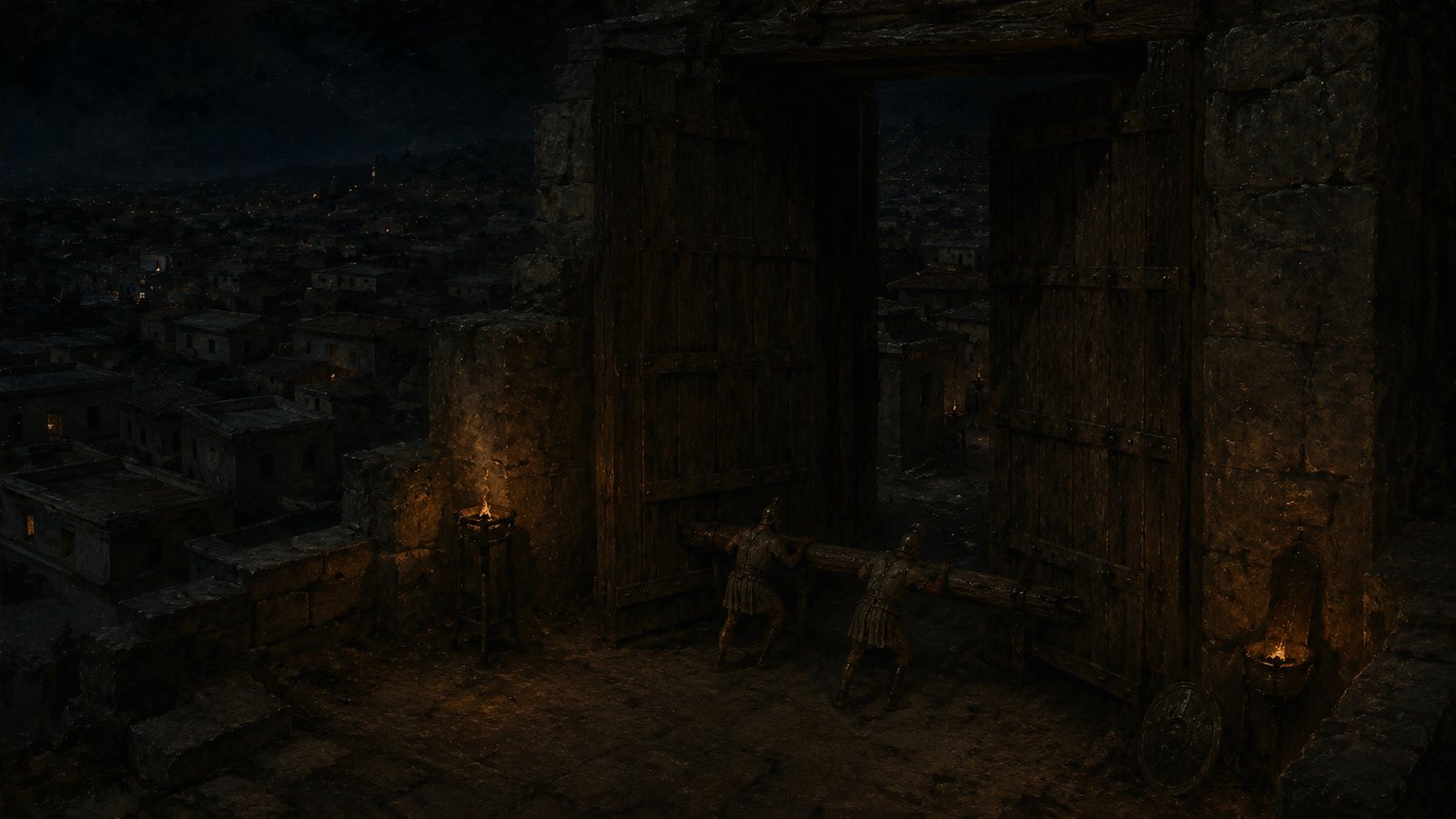
Nolan builds the film on xenia — the ancient host-and-guest bond, which the movie calls Zeus' Law. Three thousand years ago you traveled at the mercy of strangers; the whole system rested on the promise that a stranger would be fed rather than killed. The horse breaks that promise. You surrender, you offer a gift, you lie, and in the night you open the gates.
Nolan has said outright that the horse is Odysseus' tragic flaw — the mistake everything downstream flows from. Not a triumph. The moment the world's basic trust was proven worthless, by him.
A stranger could be a god in disguise. He made himself the argument against that.
trojan-horse-soldiers-opening-gates.jpgRead the monsters as confessions
The cyclops. Men hide inside an animal. They are taken in by someone with no reason to expect treachery. They wait for dark, they blind him in his sleep, and they escape strapped under the bellies of his own livestock. That is the horse, beat for beat — except here the man in the cave is a monster, so it reads as survival instead of butchery.
And note what he calls himself in there. Nobody. He spends the entire episode as no one, does the thing in the dark, and only screams his real name back at the shore once he's safely out to sea — the mistake that costs him the next ten years. The man who did it wasn't him. Nobody did it. He can only reattach his name to himself at a distance, and the instant he does, he can't go home.
We told them the war was over. We gave them a gift. We went in while they slept and killed people who were not soldiers.
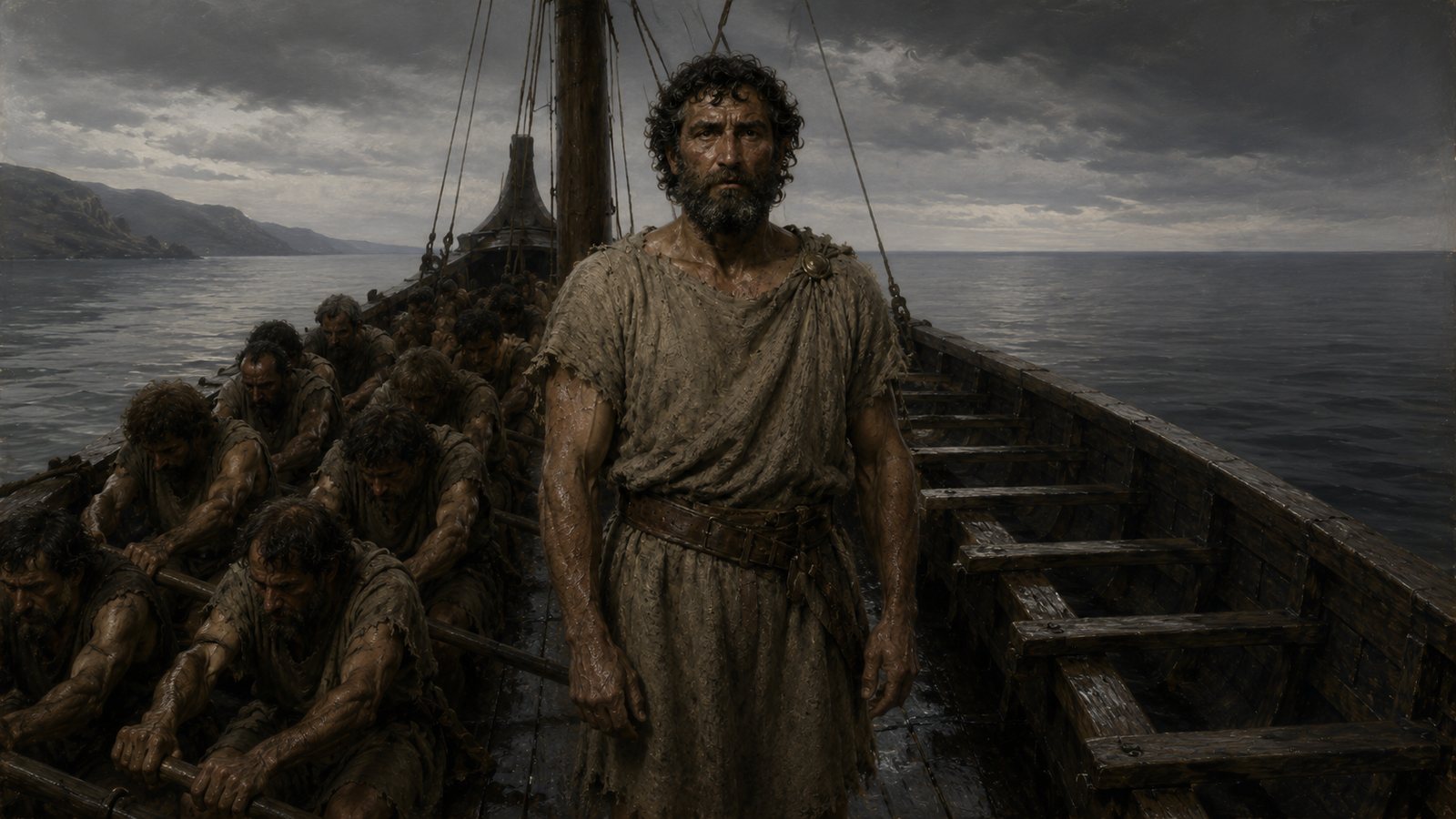
Scylla. This is the tell. He's warned in advance and given the arithmetic: one route swallows everyone, the other takes six men and lets the rest through. He picks the six and does not tell the crew, because telling them means mutiny and means everyone dies. The men are plucked off the deck screaming his name. Afterward his friend says the thing that hangs over the whole voyage — you knew this would happen.
He did. A cyclops can be fought. Scylla exists precisely so that nothing could have been done.
I did the math, chose which six of you to spend, and kept it to myself so you'd keep rowing.
scylla-six-empty-rowing-benches.jpgThe sirens. Strip the enchantment and ask what they actually sing about. In Homer, the answer is Troy. They call him by name and promise total, unfiltered recall of the war. That's the lure. That's the thing that would kill him.
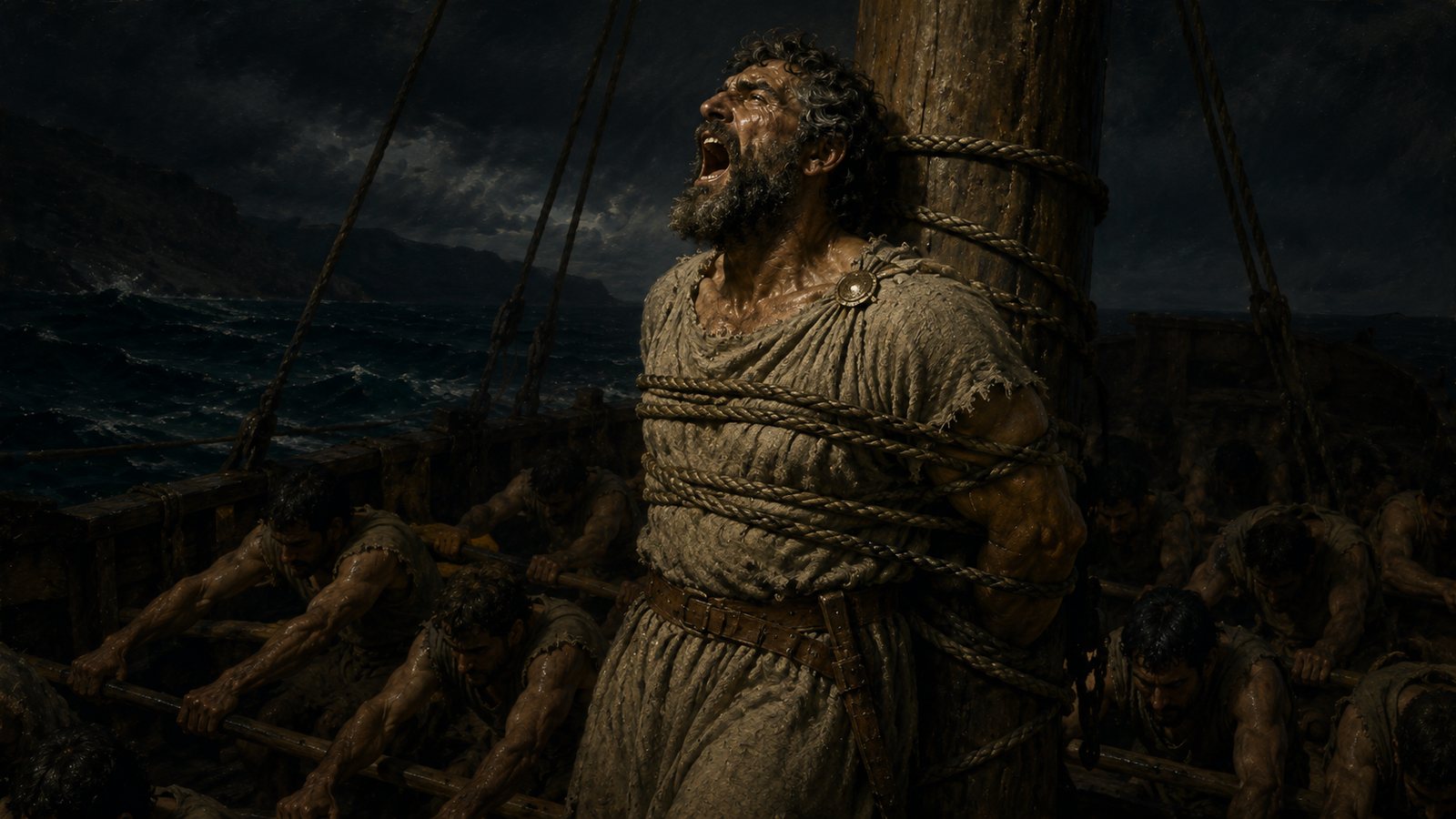
So he plugs his crew's ears so it can't reach them at all, and has himself lashed to the mast so that he can hear it and survive hearing it. He begs to be released. They tie him tighter.
That is not temptation. That is a man building the only apparatus that lets him approach the memory — restrained, supervised, unable to act on it. He's the only one aboard who needs to know what happened at Troy, and he has arranged the ship so that knowing can't destroy him.
I want to remember all of it. I have to be tied down first.
odysseus-tied-to-mast-sirens.jpgThe dead tell him to hide his name
Hades in the Greek imagination wasn't punishment. Everyone went there — hero, coward, king, laborer alike… Or was it? Every man he watched die at Troy is down there. Every man from his own crew. They can't leave. He can.
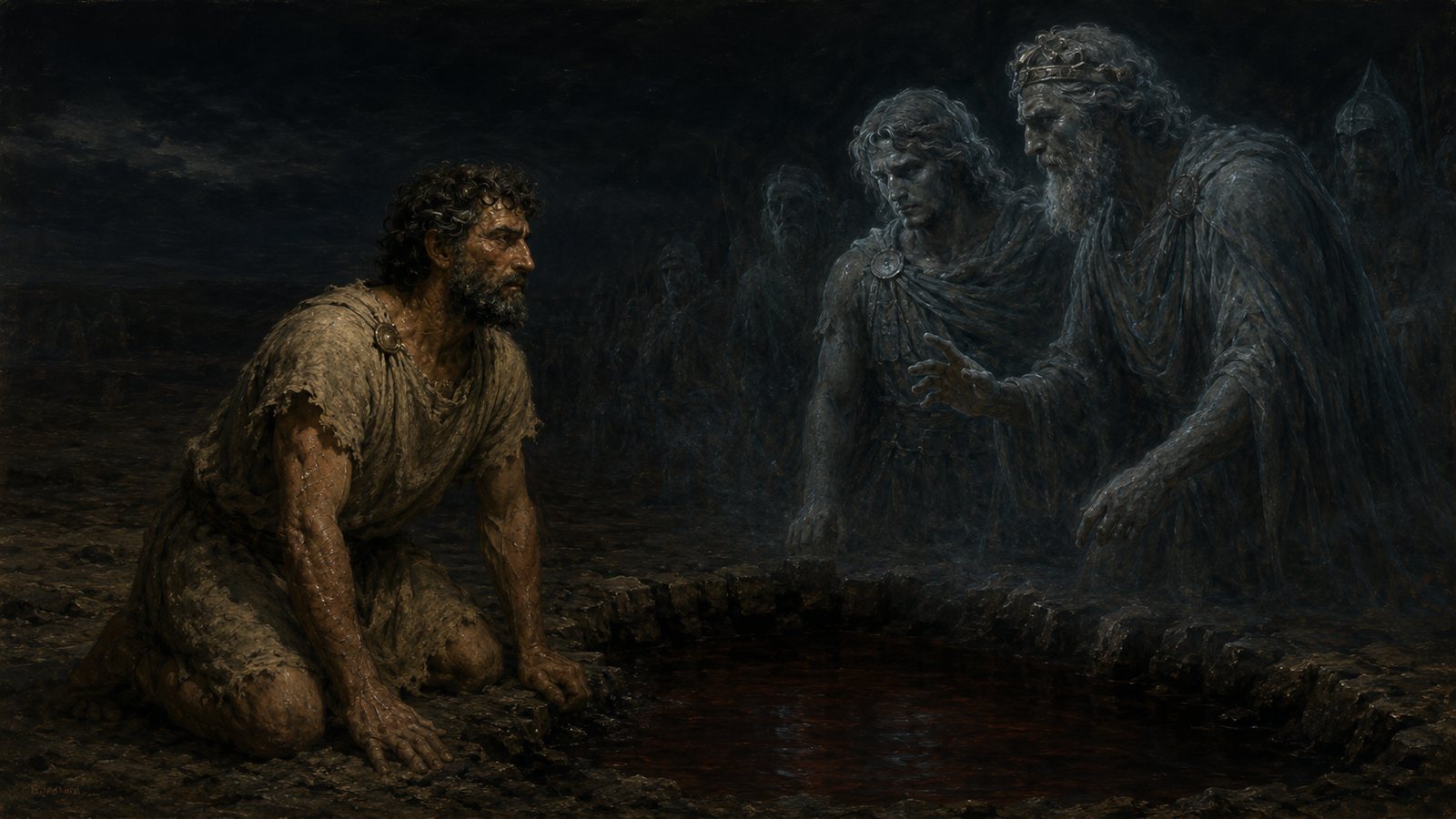
Homer hands you the strongest evidence in a scene that gets talked about less than it should. Odysseus meets Achilles in the pit — the ultimate warrior, the man who chose glory over a long life, who took the deal every soldier is told to take. Achilles tells him, straight to his face, that he'd rather be alive breaking his back for the poorest farmer on earth than dead ruling all the shades. The greatest hero of the war says his choice was wrong.
So — why didn't he stay? Everyone he lost was down there. They didn't leave; they couldn't. He had the choice they didn't. Going back is the burden, not the reward. Survival is what every one of them wanted, and he's the one who got it, carrying it out of the pit alone.
And then Agamemnon gives him his instructions: come ashore in secret, announce nothing, trust no welcome. He says it because he walked in his own front door, home from the same war, and was cut down at his own table. The advice to stay concealed comes from a man who died of being recognized.
Sit with what that means. The order to hide his identity is issued by the war dead. The split isn't only something that happened to him — in that pit he receives it as counsel, from the only people who understand what he did, and he obeys it for years. Rags, false names, nobody told. Sanctioned by corpses.
We honor them by staying alive isn't only what he says to his men on the way. It's what he takes from the dead.
And it's the one episode that has always read as interior rather than geographic. A man in a hole in the ground, talking to people who aren't there.
odysseus-hades-blood-pit-agamemnon-shades.jpgThree times, and the third one is to his son
Watch the line come back. We honor them by staying alive.
He says it at the cyclops, when the men want to stop and bury their dead properly, honorably — and he tells them that if they stay, they die. He says it again at sea. And he says it once more at the very end, to his own son, mid-fight, when the boy wants to do the honorable thing.
Three times is not decoration. Three times is a thesis.
What he's really saying, every time, is I did what I had to do to survive. And it isn't preaching. Listen to the pitch of it — it's a defense. He is relitigating his own case to anyone who will hold still, for twenty years, because the one juror he needs hasn't acquitted him… himself.
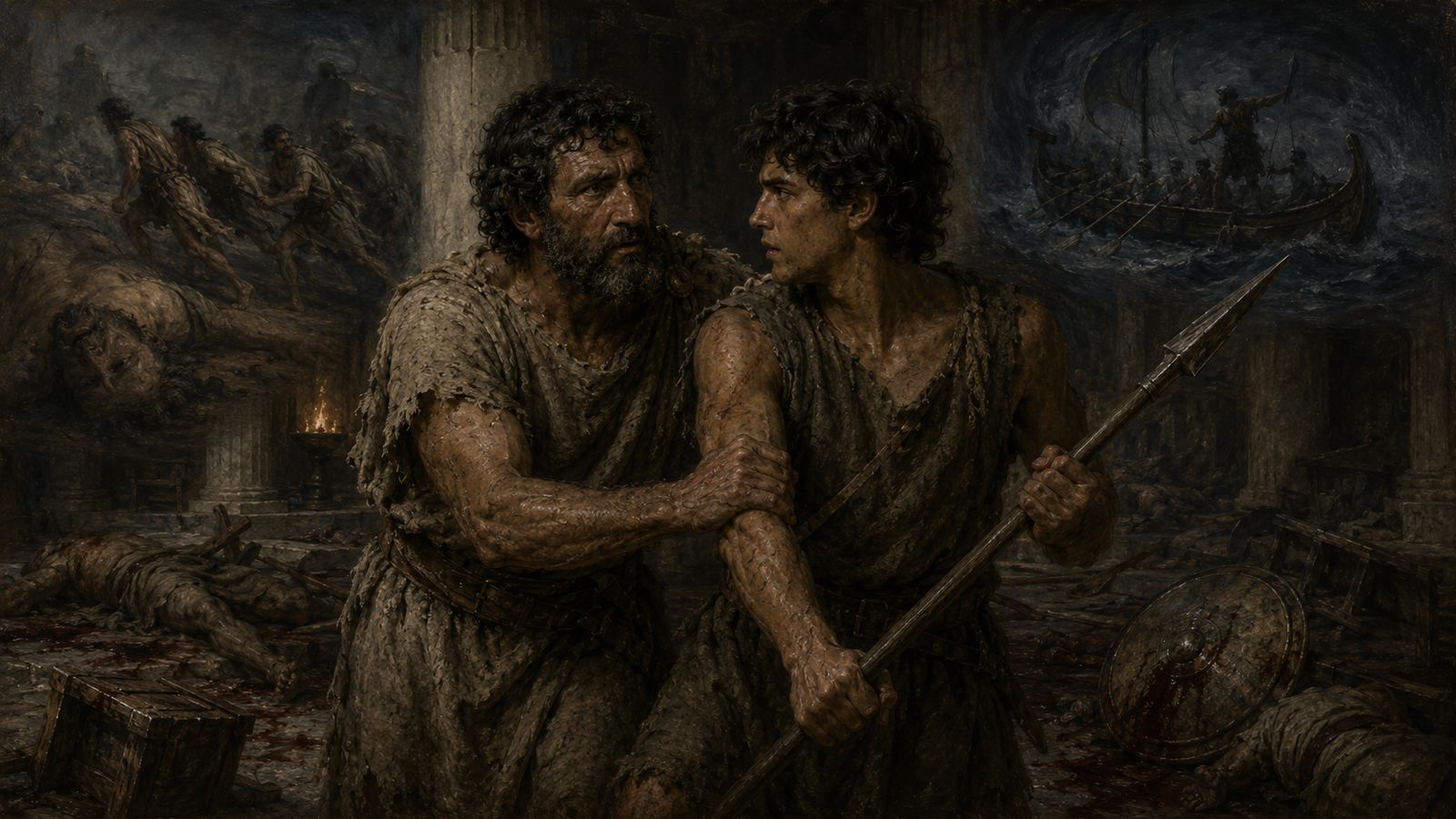
odysseus-telemachus-no-honor-only-survival.jpgThere is no honor in war. There is only survival. That's the verdict that lets him go home.
The woman was already dead
The character who walks beside him, who he takes for a goddess, appears in the sack of Troy as a priestess in the temple of Athena. The Greeks behead her.
He has been carrying her the entire voyage. She is what the horse did, given a face and permitted to keep him company. And when she finally asks whether he remembers, there's no rope this time and no wax in anyone's ears — and Troy comes up whole, literal, no cyclops, no whirlpool, just men doing what men did inside a burning city.
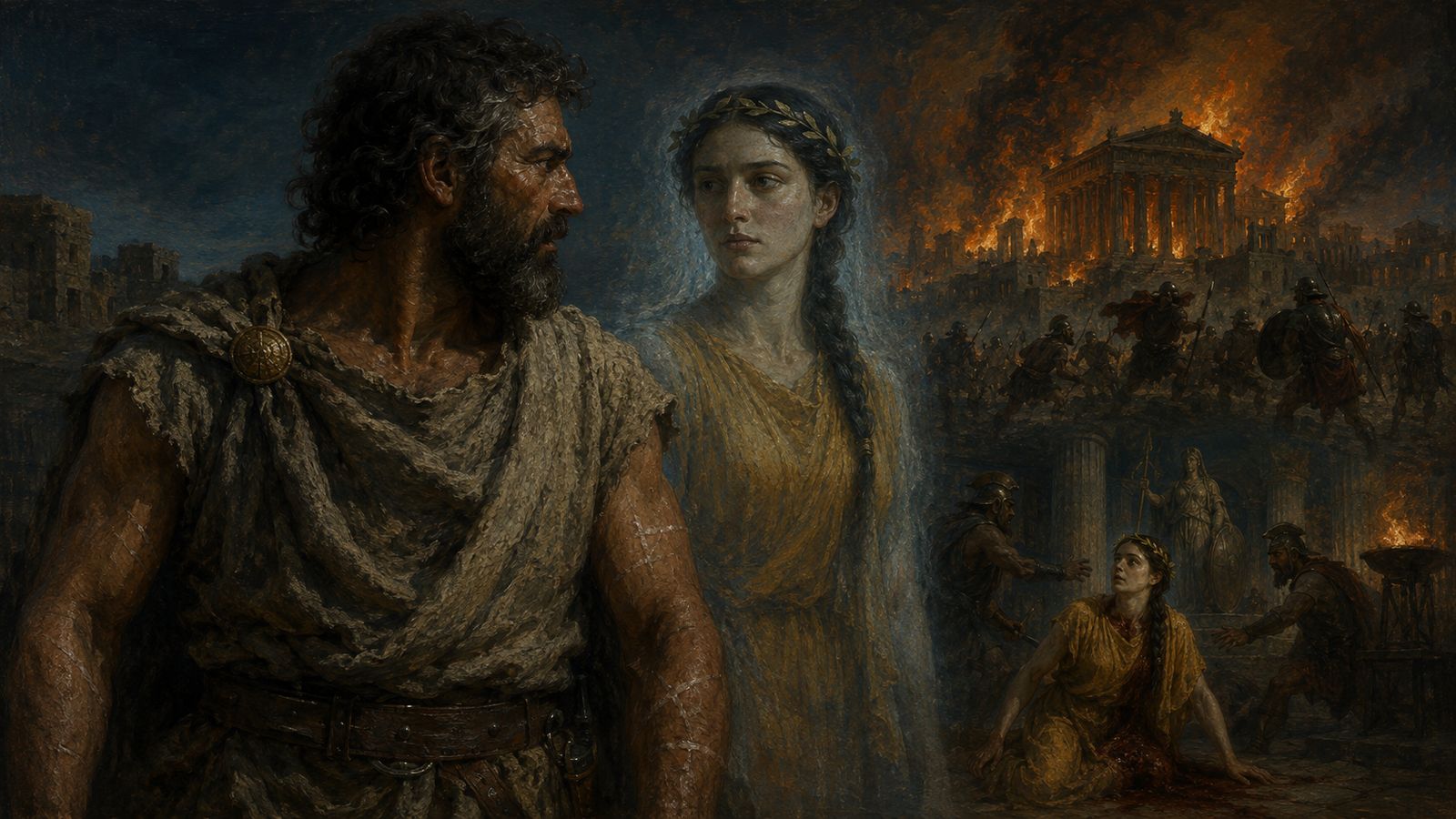
odysseus-athena-priestess-temple-troy.jpgNolan won't confirm any of this, and he shouldn't. Asked directly whether she's a goddess or a manifestation of guilt, he declines — he says he learned with Memento that it's unfair to define the experience for the audience. But he also says he wanted the gods seen the way people of that era saw them, in nature and in the people around them, and that when Odysseus talks about divinity he's a man protesting a little too much. The film's own line, quoted by Nolan: "Don't look for gods in men. You'll just be disappointed."
The pieces were him
She asks him if he remembers. He does now. Then she asks him if he wants to stay. Be happy. Stop.
He says yes. He means it.
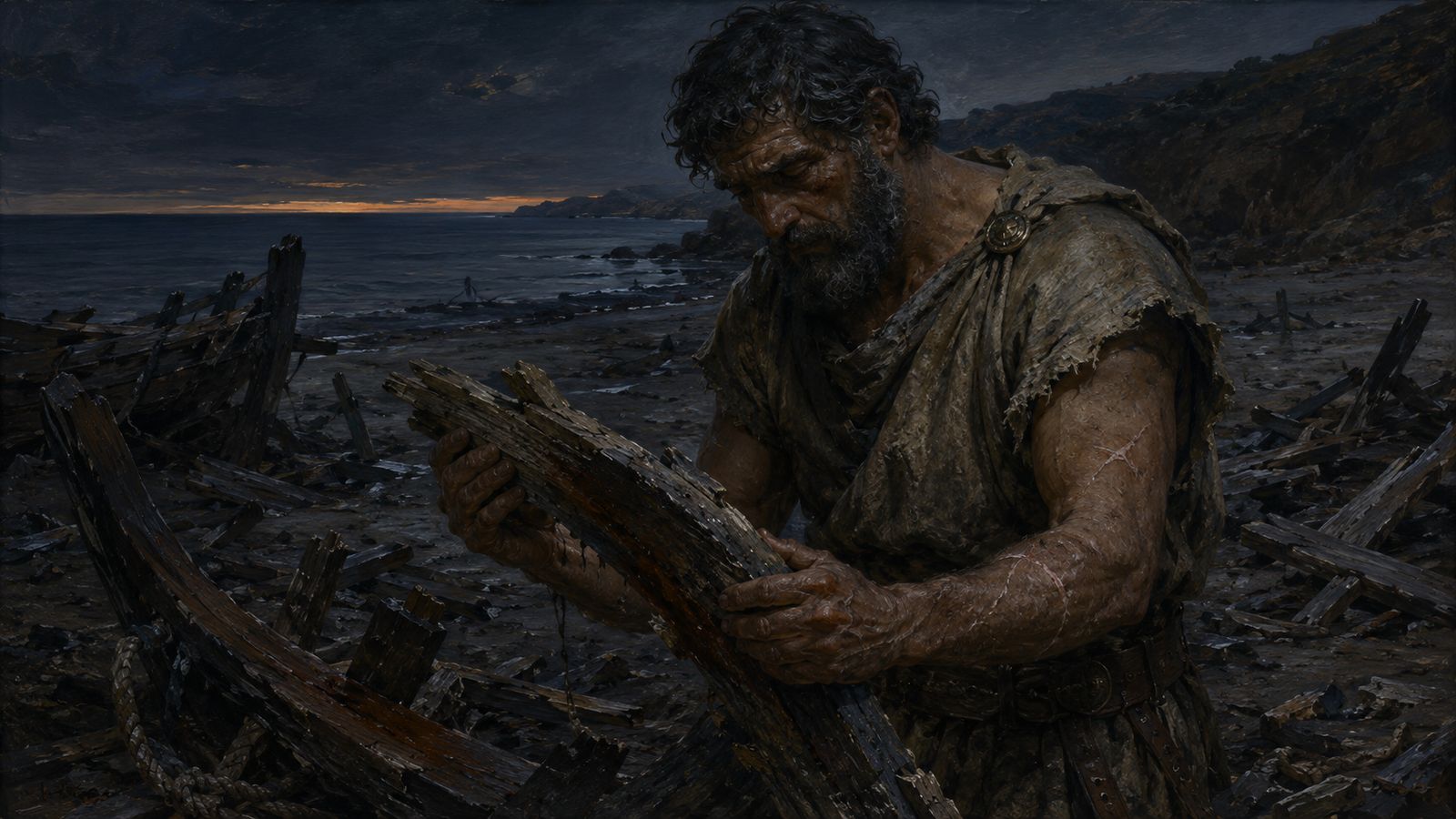
But watch what his hands are doing while his mouth is saying it. There's a shipwreck on the beach — his ship, or what's left of it — and he's walking it. Picking pieces up. Turning them over. Holding them.
Someone who wants to stay doesn't gather timbers.
The wreck is him. Twenty years at sea, and everything he assembled has finally broken apart and washed up in front of him, and he's touching each piece to see what he still has. That is not a scavenger. That is a man taking inventory.
And then the pun the film is quietly making. He can't get one without the other. Pieces to peace. The route runs straight through them. Not with her. Not by staying. Not by surrender.
Look at the arc of his hands across the whole story. He built the Horse — the assembly that destroyed a city. He walks a beach rebuilding himself, piece by piece. And then he goes home to build one last thing.
He didn't leave her because he didn't want to stay. He left because his hands already knew what they were going to do.
odysseus-shipwreck-pieces-of-himself.jpgHe gets himself back by carpentry
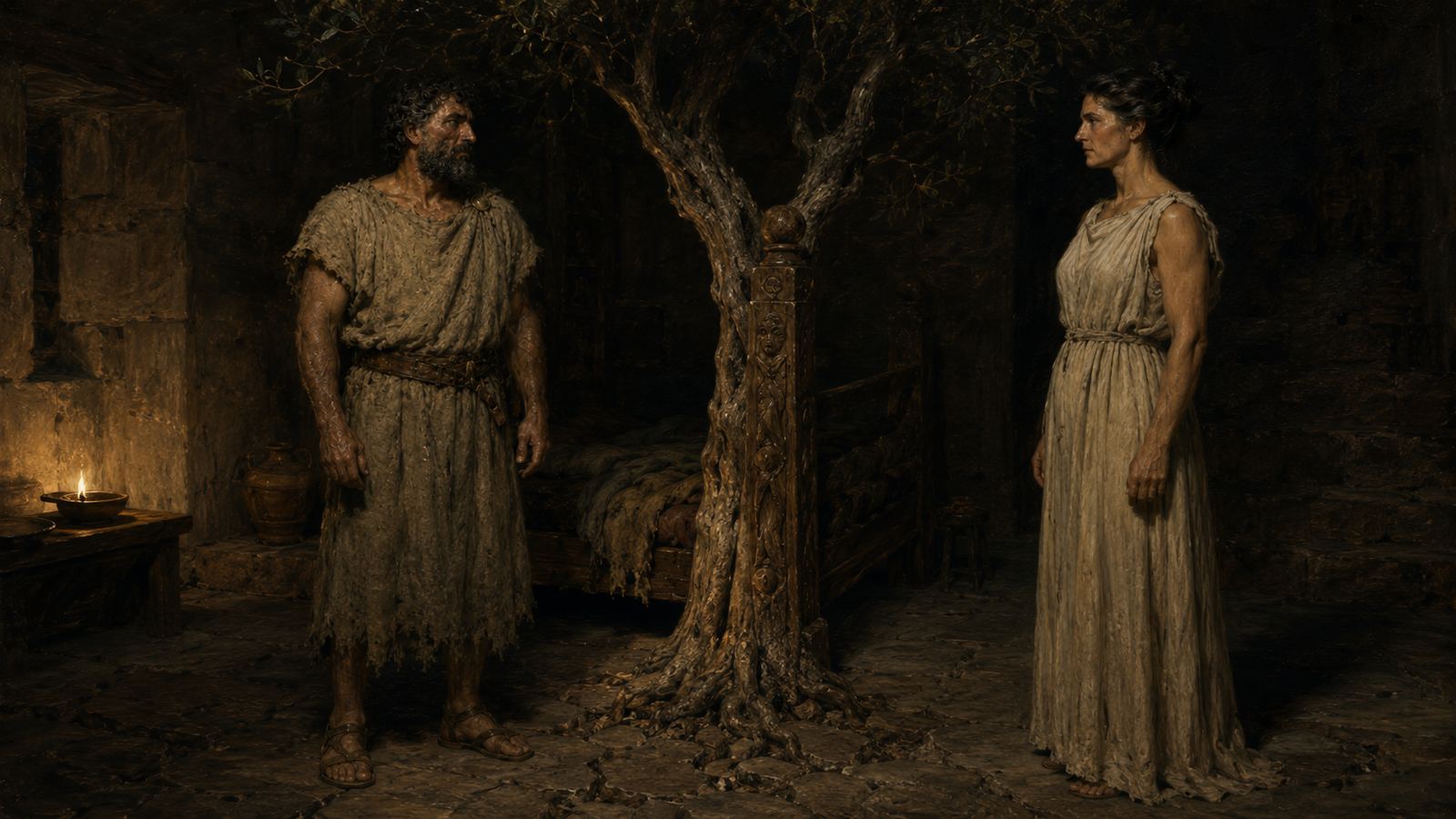
The recognition isn't the bow and it isn't the killing. His wife orders their bed carried out of the bedroom, and that's what breaks him open — because he built it himself from a living olive tree still rooted in the ground, and it cannot be moved without cutting it down. Nobody alive knows that but the two of them.
So the thing that finally restores his name is not anything he did at Troy. It's something he made at home. Rooted, immovable, still alive.
odysseus-penelope-olive-tree-bed.jpgAnd they lived happily ever after…
Why?
Because that's the way stories, and fairy tales, and myths have always been told. Because it's palatable. We want the happy ending.
So it was only fitting. The boy becomes a man and becomes king of Ithaca. Odysseus and Penelope sail into the sunset, and live out the rest of their lives together — happily ever after.